Wednesday, September 26, 2012

Games People Play

I just read Eric Berne's book 1964 book Games People Play and it's a fascinating piece of psychology. The author is an expert on human self-deception and the real meaning of rituals. For example, he gives this example of a typical American ritual:

1A: "Hi" (hello)
1B: "Hi" (hello)
2A: "Warm enough for ya?" (How are you?)
2B: "Sure is, Look's like ran, though." (Fine, how are you?)
3A: "Well, take care of yourself (Okay.)
3B: "I'll be seeing you.
4A: "So long."
4B: "So long."

 The exchange is not intended to convey information. Indeed, it's polite to not exchange information. Rather, it's simply a ritual of exchanging 'strokes' that build trust and convey interest and empathy, that is all. There are all sorts of such rules that are culture dependent, why it is so important for children to learn 'how to be polite', which means, how to engage in everyday banter that isn't about what it's superficially about.  I remember as a child finding the phrase 'how are you?' to make little sense (no one wanted to know!), and wish I read this at 13.

There are many rituals and pastimes where people don't mean what they say and Berne's book is geared towards cases when people engage in repetitive behavior where both parties appear to having a continued struggle, but really are in a rut that is at some level satisfying to both, as when an argument between family members always ends with doors being slammed.

I think Freud's a quack, as his childhood sexuality thesis is absurd and his convoluted diagnoses cribbed from reading too much Sherlock Holmes (see Sebastiano Timpanaro's essay in Unauthorized Freud). But he's was on to something, and and all such talking cures (such as Scientology's auditing) rely on uncovering people's hidden motives, the ones that underlie the games outlined in Berne's book. When enlightened people are forced to confront these they are better off.

 It's always interesting to notice people you understand better than they do themselves, sad sacks who make similar mistakes over and over, and seem totally oblivious to their bad habits of thought. They rely on a strange cognitive dissonance that keeps them from really seeing themselves. I noticed it once in myself when I met an old college friend and he said, 'remember when you did X because Y!' I don't want to go into it (X and Y weren't that shocking), but in any case I had remembered my reason for X as being more reasonable. I then realized it was obvious I had lied to myself for decades.

We all lie every day, usually about inconsequential things. It's important to understand how often and easy it is to lie to ourselves, a theme in Jonathan Haidt's The Righteous Mind, and Michael Gazzaniga's work on split brains (the inarticulate part of our brain guides our thoughts more than our inner narrator). Indeed, the most unethical person I ever hope to know emphasized to me several times that 'honesty' was the most important thing to him, and he was probably unaware at a conscious level this was precisely because he knew how much he lied about important things. And so it is with many experts who not only lie to themselves, but do so about things they are expert at, or prioritize. Consider that active portfolio managers lie about their alpha, partisan intellectuals distort their opponent's arguments to make them easier to dismiss, and politicians lie about being leaders rather than slavish followers.

Back to Freud, he was always the smartest, most articulate person in the room, and coming up with clever solutions like Arthur Conan Doyle for personal problems using allusions to Greek literature and sex, all very impressive.  It allowed him to believe he was like a Newton for the human soul. He was lying to himself that he had discovered such laws in our thoughts.  This is not a paradox, it's the human condition, because for many of us clarity on the things most important to us is depressing.  It takes courage to see oneself objectively because we are all fallible and imperfect, and prefer not to think about our faults but rather the faults of others.

My kids are young and learn a lot every day.  I like to think I too am learning as much about life, even if not at their frenetic pace. I notice many adults adopt habits of thought and behavior that go pretty unchanged after a certain point.  It's as if they tire of the grief that comes with learning we are going about things sub-optimally because this causes us to re-evaluate all sorts of things about ourselves. Thus, wisdom seems to flat-line as opposed to increase throughout life like for Plato. I definitely want to avoid being one of those people others know better than I know myself.

 As Feynman said in his Cargo Cult lecture, "the first principle is that you must not fool yourself--and you are the easiest person to fool." He was talking about science, but this virtue of self-honesty is not compartmentalized, but rather a virtue you practice every day on things great and small.

Monday, September 24, 2012

Volatility Risk Premium

One of the more alluring investor myths is that you can get paid a premium for having the patience to withstand risk. It's like getting paid more for working at a smelly job rather than a job surrounded by wonderful smells: in equilibrium, the bad thing no one likes (risk, smells) are compensated via an extra return. You can formalize this and it forms one of the pillars of finance under the rubric of 'risk premiums'.

 Yet, as I point out in my book The Missing Risk Premium, to a first approximation the risk premium has a negative sign. Using Popperian logic, the profession should have moved along a long time ago, but it persists for several interesting reasons that I discuss in my book (eg, it's beautiful if true, it's a key fallacious assumption that underlies so many other threads, etc.).

Now there's PIMCO writing about how to capture the 'Volatility Risk Premium' by selling vol. They correctly note that on average, implied volatilities are a couple percentage points higher than actual volatilities, so 2% higher. Thus, it seems clear that writing options, collecting premium on 22% and paying on 20% generates a straightforward premium.

 Consider what may appear to be a great example of their argument: the VXX. it has lost 97.8% of its value since inception in January 2009, while the VIX has only declined by 66.8%. Win for risk-taking volatility sellers!


This phenomenal extra 8% annualized negative return drag (underperformance of VXX vs. VIX) comes from two sources.  One is the fact the VXX tries to match the daily return, and in sample that have negative autocorrelation, this strategy will underperform its benchmark over long periods.  This is best shown by this piece by Cheng and Madhavan at Barclays.  The other is the contango in this market, so that trying to maintain a fixed forward volatility position causes one to lose money riding down the VIX futures curve which has been very steeply sloped since the inception of this stupid product.  

That gets to the bottom line, which is that the premium of going short the VXX has little to do with risk--it's negative return is much bigger than any estimate of the equity risk premium--but rather technical issues within the contract.  You can try to capture this by trading yourself or becoming a short seller, but this highlights that to capture a return premium you need to actively educate yourself and put on positions that take at least a little work (eg, shorting the VXX is more complicated that simply going long the VXX), not passively invest in a fund that has 'risk' and does this all for you.  

If a fund purports to give you a risk premium for simply giving them money it's a classic sucker's pitch.  Consider that after 50 years there's no agreement on what the risk factor is: originally it was a beta with the broad market, now it's a covariance with something, though interestingly things correlated with well-known risk factors like 'size' or 'value' don't exist outside of the characteristic-based portfolios that actually create these factors.  That is, if you find a currency, or low book equity/market equity stock that has a high value loading, these assets don't generate higher-than-average returns as theory suggests they should. So, if you magically discovered the risk that underlies risk premiums, it would be in your best interest to keep it to yourself, not give it away to investors, and call it alpha, because no one would know. 

It simply isn't plausible people are finding risk premiums and giving this to passive investors, and naive investing is just what underlies all those fools going long the VXX in hopes of making money off Black Swans. While selling vol (shorting the VXX) is in a certain way selling Black Swans, the similarity is that some 30k foot metric like improbability is something you get paid for, whether you are buying or selling it.  You have to roll up your sleeve and earn it, taking out those pesky middle-men.  

Sunday, September 23, 2012

US Corporate Tax Rates High

A new study on corporate tax rates makes the point that US corporate tax rates are rather high. I didn't realize this, so I thought it was interesting. There study is here, but like all good empirical research, the gist is in a simple graph:

Thursday, September 20, 2012

Leverage Aversion and Portfolio Optimality

There's a strange article, Leverage Aversion and Portfolio Optimality,  by Bruce Jacobs and Ken Levy in the FAJ. It's not clear what their paper is trying to explain. That is, a theory should either predict something new, integrate two seemingly separate results, or explain a paradox to standard theory. This paper seems to merely show that if people explicitly take into account leverage, then portfolio holdings will be different. They don't even reference Asness, Frazzini and Pedersen (2011), the most recent piece on this subject.

But their piece is strange in several ways. First, they implicitly have people maximizing 'relative returns', what they call 'active return' (with the leverage constraint added on).  On one hand, this is great, because is consistent with my thesis in The Missing Risk Premium, that this is what most people actually are maximizing.  Yet, they propose this as if it is de rigueur. This highlights that 1) this utility function is so intuitive people generally don't even think about justifying it on more general grounds and 2) they blithely ignore the many contradictory implications of this assumption applied generally (eg, a zero risk premium).  Yet, if the utility function is relevant it can't exist parochially in one asset class without a massive arbitrage opportunities.  I know a foolish consistency is the hobgoblin of small minds, but this parochial-general distinction as applied to equilibrium returns is not foolish.

 Secondly, their model seems to imply that with 200 and 300% enhancement funds available via leveraged ETFs (Ultras, UltraPro), does this then imply the expected return on these sectors is now lower because people can buy a 200% allocation to these sectors without direct leverage (ie, you 'only' lose 100% with an ETF)? Do stocks with options have lower expected returns because of these outlets (options are levered positions that, when long, 'only' lose you 100%)?

Lastly, they imply that everyone should be leveraged somewhat.  Now, on one hand this is obvious because if they are maximizing relative return, and they presume some alpha, there's some non-negative allocation regardless of how risk-averse one is. This was proven back in the 1960s via the symmetric problem of how much of an allocation one should apply to a risk portfolio when you have absolute utility. If your theory says 'everyone' and the data say much less than half, the theory's wrong. It's a much bigger disagreement than the theory saying 80% and data saying 40%.

Wednesday, September 19, 2012

All Good Ideas Go Too Far

Willie Stark (aka Huey Long) in All the King's Men:
"Im going to build a hospital, the biggest that money can buy, and it will belong to you. Any man, woman, or child who is sick or in pain can go through those doors and know that everything will be done for them that man can do. To heal sickness, to ease pain, free - not as a charity but as a right. And it is your right, do you hear me? It is your right. And it is your right that every child should have a complete education.
The Chinese are currently willing to subsidize our plethora of economic rights, but I wish they would stop so we could adopt a truly sustainable balance between rights and revenues. Alas, Romney's latest Kinsley gaffe has set off a firestorm of outrage because it hits home: many people are sustained by perpetual forced charity. Clearly charity is good in some situations--temporary help, even permant help for those truly disabled--but the system is now out of control.

No one likes to think of themselves as parasites so their benefits are redefined as rights, or no different than social security or those taking advantage of tax breaks. Yet taking food stamps and avoiding federal taxes through muni bonds, are fundamentally different. Many would like us to believe that all these omnipresent mandatory transfers (social security) and tax incentives make us all equal recipients of government aid (argued as well as can be by Mark Schmitt here).

 The bottom line is that Arthur Brooks is right when he says people only gain satisfaction via earned success, not charity. This is why, if you want to gain someone's affection, you should ask them a favor as opposed to doing one for them, because the former implies they are truly valued for something they can do, whereas anyone can receive charity. Those who advocate redistribution therefore are strongly incented to convince others and themselves these cases are not charity, but no different than a tax break on muni bonds, or simply a human right that exists via natural law. In a similar way affirmative action supposedly doesn't mean targeted groups are on average less qualified, but you can tell no one really believes this because people get so very emotional if you ever mention this to an affirmative action supporter (people don't get excited when you say 2+2=5).

Tuesday, September 18, 2012

The Easiest Way to Make Money

Former UBS banker Bradley Birkenfeld won $104m for exposing the giant Swiss bank’s efforts—illegal in America but not in its home country—to help American taxpayers hide money in offshore accounts. I think the take-away is that any organization involved in large-scale illegalities should realize that the incentive to turn over insider evidence is huge now, and this should dissuade law-breaking of this scale, which is a good thing. However, a huge organization will necessarily have many gray areas because bidding is strategic, and so could always be seen as conspiratorial by some, or have disparate impact. Thus, this probably massively increases the amount of bureaucracy that already weakens these companies.

 But it does create jobs. Here's The Economist on the whistle blower's lawyer:
His lawyer, Dean Zerbe—who wrote the relevant legislation on informants in 2006 while serving as tax counsel to the Senate Finance Committee, and with other lawyers will share in an estimated 10-33% of the reward—says he has two dozen other cases pending, two of them bigger than Mr Birkenfeld’s. His phone has rung incessantly since the settlement.
Writing complex legislation has its advantages.

Monday, September 17, 2012

Utilities and Low Vol

I spoke with Ben Levinsohn last week, as he's a pretty good guy for the WSJ who writes about low vol on occasion.  He took this snippet out of our conversation:
"If you want low volatility, you should get utilities and not worry about it," says Eric Falkenstein
Alas, that's not exactly what I meant, though I did say it.

What I was trying to say was that while a low volatility strategy has more of a utility weighting than the S&P, your average low vol investors should not to worry about it. A low volatility focus dominates the indices, which dominate active portfolios, which dominate picking individual stocks. So the 'low vol' focus should be encouraged.

Here's the weighting of the Russell 1000 by industry sector, by value-weighting and count:


Now, if you apply a filter so you grab the bottom 20% of stocks with the lowest beta or volatility, here's the allocation you get, both by count (equal weighted), or market cap (if you allocate via market cap), where the percents are relative to the Russel, so that 20% would be neutral (because I'm choosing the bottom 20% of stocks):


There are several ways you can make low vol better, and utilities, historically, don't seem to be the secret sauce of low volatility. Below is the total return index for 10 major indices since 1927, and utilities are near the bottom in total return. As low vol has historically out-returned high volatility, this clearly suggests utilities are a drag on the strategy.


Yet, if you get worried about this nuance, you probably will get led down the path of gilding the lilly, making things worse in an earnest attempt to do things better. I mean, if you restrict utilities, what next? Value (because that overlays one's value allocation)? How about industry caps in general? While I think there are better ways to play low volatility than SPLV, for most people this is their best play.

I don't talk about tactics I think really add alpha because really good specific ideas are better kept off the web: the masses will dismiss them, and smart people will steal them without attribution. Big strategies are useful to discuss in public because they are interesting and too big to be a secret anyway.

As most people screw things up doing it themselves, usually by adding a signature flare (most new ideas are bad, after all), most people will ruin the benefits of low vol by noting that utilities detract from low vol.  In practice people don't stop with just one refinement, to their detriment.

If you can afford or know someone really good (ie, in the top decile), do it fancy, but otherwise, simpler is better.

Wednesday, September 12, 2012

A Bad Way to Fight Bears

Sometimes I hear that you can't trust everything you read on the internet. The following 'Interview Questions' cheat sheet doesn't help:
Q: How would you fight a bear? 
A: Climb on its back and grab it by the neck so its paws can't reach you.

Failure of LVOL Highlight Theoretical Flaw

Russell Investmests recently announced is shutting down its ETFs due to lack of demand: 25 funds with only $300MM in assets. A signature fund was LVOL, which actually was one of its more popular funds with $70MM, and was primed to pick up the hot low volatility investing trend.

It took a factor approach to the low volatility focus, first creating a 'volatility factor proxy', and then choosing 100-200 stocks from the Wilshire 1000 that load up on this factor. As the 'volatility factor proxy' selects stocks itself, this approach is too convoluted, and investors rightfully don't trust black boxes, which given weasel word language about momentum and beta. Their LVOL overview page is completely unhelpful, with just about every tab containing either the same pie chart of sector weightings, or regulatory boilerplate and irrelevant data. Indeed, the regulatory language clearly gets in the way of communication, highlighting that financial regulations are generally the opposite of helpful.

 In contrast, SPLV says on its home page
The Fund will invest at least 90% of its total assets in common stocks that comprise the Index. The Index is compiled, maintained and calculated by Standard & Poor's and consists of the 100 stocks from the S&P 500 Index with the lowest realized volatility over the past 12 months.
It's clear what they are doing, and they aren't trading too much (eg, monthly as with LVOL). If you spent time learning advanced financial theory, you would learn that LVOL did it right, SPLV did it wrong, because factor loadings are the measure of risk, not mere characteristics like volatility. That the whole field has a big flaw is a theme of my new book( available in paperback and Kindle!).

 Too much schooling is a bad thing. Recently I was working with my publisher, a subsidiary of Amazon, and their structure was clearly created by an MBA: I had a team with specialists who handled very narrow tasks but somehow were never the right person to comprehend any of my specific questions (eg, β should be different than b?). They all spoke as if they were reading from a script, and often I would find their unhelpful verbal answers on their website's FAQs. The fact the actual typesetters were in India, and I could never talk to these people, I'm sure made sense to the top guys at Amazon, who are traditional Harvard-educated efficiency experts. I have a feeling monks from 12th century Ireland were more accurate and faster.

 It's bad enough grad school costs too much, but it makes you less efficient.

Monday, September 10, 2012

Why I'm a Fama Fan

Aaron Brown was gracious (and insightful!) enough to give a rather nice review on Amazon for The Missing Risk Premium (paperback here, Kindle version here) and at Minnyanville. You can read it there. One point I made he found irksome was where I noted my Northwestern professors considered Fama a 'lightweight'. This was back in the early 1990s. Unfortunately, he inferred something I didn't intend, namely that I too considered him a lightweight in the way many opinion columnists will write 'some say welfare reform is a racist dog-whistle', so they can say and not say it simultaneously. I replied via a comment on Amazon and to him personally, and he accepts my explanation as no mere tendentious parsing of that statement (though clearly, when people don't infer what I imply, I'm guilty of not saying things as well as I could).

My point was not that my professors were uniquely wrong, just that conventional wisdom then thought the best research was examplified by the rigorous work of people like Jay Shanken, Michael Gibbons, or Stephen Ross. These papers emphasized rigor, issues such as jointly estimating betas and alphas, or whether to use Lagrange Multiplier or Likelihood Ratio Tests. The thought was that the theory was basically correct, where expected returns are a linear function of a covariance with something, and so the really important insights would be found via ever more sophisticated econometric techniques.

 It wasn't a dumb idea, but it was wrong. CAPM betas couldn't be saved, and rejecting them via these tests didn't really point to what was wrong. Fama is now one of the most respected names in finance because he has championed a model that seems to work, and part of his persuasion involved simply cross-tabbing average returns by size, then beta. This showed that the standard CAPM betas were untenable as measures of risk, because when one does this beta is unrelated to average returns, and these average returns are our best estimates of expected returns. He not only changed the focus from covariances to long-short portfolios that (conceivably) proxy a risk factor, but from abstruse statistics to cross-tabbing.

 I admire Fama for his clear arguments, his intellectual integrity (he changed his mind on the CAPM betas, he didn't jump on the momentum bandwagon and merely said 'it's a puzzle') and also his defense of efficient markets, which is often maligned by to my mind remains a pillar of finance. That is, a healthy respect for the default assumption that it simple profit rules are rare is valuable disposition, otherwise one chases all sorts of overfit will-o'-the-wisps. So, my mention that Fama was once considered a lightweight was meant to give some color to how finance has changed in methodology, which is reflected by what kinds of research and academics are considered top shelf.

 Rigor is a good thing, but it should never be more precise than the data allow, and as most of our tenable theories are simply about whether certain coefficients are zero, positive or negative (eg, for CAPM betas), not what the 11th digit is, the distinction between Wald, Likelihood ratio, and Lagrange Multiplier tests is moot. Unfortunately, there is still a rigor bias in financial theory, why so many important results are in lesser tier journals like the Journal of Emerging Markets, the Pacific-Basin Finance Journal, or the Journal of Empirical Finance. If the finding only arises from a GMM estimate of parameters of a stochastic discount function, but don't generate a scatter-plot or total return chart, it almost surely doesn't exist.

While I agree with 90% of Fama's weltanschauung, he strongly believes in risk premiums, and I don't, and that is an important disagreement. Nonetheless, I still greatly respect the man and read almost everything he writes.

Sunday, September 09, 2012

Where Risk Taking Really Hurts

Sports Illustrated has a cover story on dementia and NFL players. They mention Ray Easterling, played for 8 years in the 1970s. They note:
Ray, who'd had a successful career in financial services, began making impulsive and risky decisions, a hallmark, some scientists say, of chronic traumatic encephalopathy...
If risk were positively related to return, one effect of this would be for many very wealthy people to be morons who took more risk than they realized. Sure, many would fail, but there should be vast riches to those who succeed. Indeed, in De Long, Shleifer, Summers, and Waldmann (1990), this is indeed the implication: wealth becomes concentrated among deluded investors who took excessive risk.

 This clearly does not describe wealthy investors. Many successful investors are lucky, and many aren't extremely bright. But very few of them are stupid, that is, have dementia or an IQ below 85. This is just another datapoint supporting my argument that risk is not positively related to return. Risk taking without intelligence is a sure path to financial disaster. If it were all factor loadings derived from covariances, it would be too easy.

Friday, September 07, 2012

What We Hate

I found this riff on David Foster Wallace interesting:
A lot of what he disliked in other people, and much of what concerned him about contemporary culture was a reflection of something that discomfited him in himself. ... he wanted, in his life and his art, to be a great deal better than he often was. (As a teacher he was hard on clever students who reminded him, either in their work or their personalities, of his younger self.)
This really rings true, but with a twist. Personally, I sympathize with those who display my pet peeves about myself, because I understand the good-faith origin of these faults (I know I mean well, and can extrapolate). In strangers, I only loathe those vices where I never feel any temptation. Yet I also loathe vices I find in myself in my immediate family because I really want them to succeed, and so feel compelled to shake these bad habits out of them out of an overbearing love only appropriate for family.

Any self-aware person knows their faults, and is especially observant of these faults in others. Yet, I'm not sure such self-knowledge is truly advantageous. Perhaps, like overconfidence, self-awareness is best done in moderation.

Thursday, September 06, 2012

New Momentum Fund

Moment is a strange factor. Historically its magnitude is comparable to value and size in Ken French's data, yet clearly less popular. Yet unlike size, value and more recently low-vol, hardly any products out there attempt to specifically harvest the momentum premium in an efficient manner. The problem is that momentum peaked in November 2008, and has not recovered (graph below using French's data).  Many think it may never recover, which perhaps is why the main momentum fund, HMTM, trades only ten thousand shares a day.


Nonetheless, my friends at Robeco launched a fund designed to capture the momentum premium (led by Willem Jellema, right). They think it will be attractive because momentum tends to do particularly well when low volatility and value fails (e.g. late nineties was horrible for value and low-vol, but great for momentum). More importantly, their fund has some secret sauce.  I can't say what that is, but I can vouch for the fact that there is a way to play momentum that works much better than the standard approach used in academic papers.

Update: I should add that AQR runs momentum funds, and Cliff Asness has been actively researching  momentum for well over a decade (see Value and Momentum Everywhere), so he probably has some special sauce too.

Tuesday, September 04, 2012

Economists Love The Spread

The spread is a debating tactic where you present a set of supporting arguments so wide and particular your opponents are unable to rebut them all because 1) they have day jobs and 2) they have limited space or time to address them in any particular forum.  A champion spreader is Noam Chomsky, who selectively recites facts of world history from Indonesia, Russia, to El Salvadore and 200 places in between, which no one but a professional in Comparative Economic Systems would be familiar with (indeed, comparative economic systems was a flourishing economic subdiscipline precisely because it couldn't be easily refuted because those communist countries didn't have a free press and made up their production data, but after 1989 it was obvious this field was simple wishful thinking dominated by deluded Marxists-note:of the ones I knew!).

So, a paper by Michael Woodford calling for NGDP targeting is a case study of a good type of argument for this kind of thing. As it is doubtful that less than 1% of his readership understands all the strengths and limitations of the model he presents, it makes for a great spread argument by Paul Krugman, because he can be sure that most readers won't have the time, inclination, or ability to assess the credibility of this paper. As with most spread arguments, they can be used by those with the opposite conclusion (eg, John Cochrane here), because a small tweak makes it support an opposite view, and who's to say what is minor when references are really recondite.

The model used by Woodford is from an older paper by Eggertsson and Woodford (2003). Kids Prefer Cheese notes this following set of quotes from that paper:
For simplicity we shall assume complete financial markets and no limits on borrowing against future income. 
Our model abstracts from endogenous variations in the capital stock, and assumes perfectly flexible wages (or some other mechanism for efficient labor contracting), but assumes monopolistic competition in goods markets, and sticky prices that are adjusted at random intervals in the way assumed by Calvo (1983), so that deflation has real effects.  
We assume a model in which the representative household seeks to maximize a utility function Real balances are included in the utility function, following Sidrauski (1967) and Brock (1974, 1975), as a proxy for the services that money balances provide in facilitating transactions.
In other words, the basic workhorse of this model was created decades ago and has been available to thousand smart economists trying to forecast the macroeconomy. If some metric of monopolistic competition, sticky prices, inflation, and real balances, predicted future investment and consumption, we would know it because there's a model that targets these variables directly, and whether a parameter is 7 or -0.3 is simple enough to change after the fact: if some parameterization worked, the model could rationalize it. There isn't such a model, as evidenced by the fact that all recessions have surprised macro economists in real time.

 Now, these are smart people, so they are very good at explaining the past, but that's really unimpressive, and reflects the degrees of freedom available relative to the target variables of quarterly GDP aggregates. It's like finding a trading rule for last year's daily S&P moves.

Don't be fooled by The Spread in economics.  All macro models are no more precise than the infamous Laffer curve, which while true at extremes and useful for some intuition, says very little about your average policy change and intermediate forecasts. Outsiders can't critique such models directly, but they can say, "what did this model say in 2007?  In early 2009?"  That is, not what does the model now say about 2008 given 2007 data, but what did it actually say in 2007?  

Wednesday, August 29, 2012

Climate Change to the Rescue

Howard Davies was Director of the London School of Economics (2003-11), so you would think he understands economics. Instead, he writes a lame criticism of a caricature of economics. In the process, he notes:
Robert May, an eminent climate change expert, has argued that techniques from his discipline may help explain financial-market developments. Epidemiologists have suggested that the study of how infectious diseases are propagated may illuminate the unusual patterns of financial contagion that we have seen in the last five years.
They might, but as climate change models use 1970s-era macro models within them as part of their feedback loop, I highly doubt it. So might cardiology, or aeronautics. That the head of the LSE thinks these fields are really fruitful suggests he has never read any of these prior attempts, which given his age, suggests he hasn't read any economics over the past 20 years. Given the strongly partisan tone to many esteemed economists when discussing their specialty on the topics of the day, I will strongly recommend my kids don't choose this as a major.

Now, I'm prejudiced to be sure, a Friedmanite-conservative, but I like to think I don't simply refute my opponent's weakest arguments via some argument like 'huh?' or some other sarcasm.  That's not reasoning.

That is, it's improbable that two essays of equal quality will receive the same grade if they are consistent with either free-market or Keynesian policies given the prejudices of the professor, which means all they learn is how to say things that support a predetermined view, which isn't real wisdom. A couple of key classes is sufficient (intro finance, intermediate micro, intro macro, game theory, derivatives pricing), and the gist of these will probably be reducible to a series of Khan Academy videos by then.

Tuesday, August 28, 2012

Bad Trades as a Macro Parable

There are two types of bad trades.  The first is the mode-mean trade where the mode is positive the mean zero or negative.  One shouldn't make this kind of investment, because at best it simply adds noise to one's portfolio.  The net return to the passive investor can be especially negative because often they mistakenly overpay for management, not anticipating the drawdown, and the agent does not payback old profits when this is all revealed. Such trades are common in financial markets, and savvy investors are very aware of them.  Junk bonds, writing out-of-the-money options, hurricane insurance, are good examples.

Another type of bad trade is where losses are expected initially, but supposedly it's just a learning curve or scale issue, and eventually once all the ducks are in a row the positive cash flow supposedly appears.  These are more common, as with any high frequency trading strategy that burns transaction costs, not realizing that those close-to-close returns used in the back tests weren't realistic estimates of feasible net fill prices.

The more money an investor has tied up in such trades the lower their total return over the long run. You can try to avoid them, but a better priority is to simply identify them and flush them when they reveal themselves. That is, getting out of bad investments is probably the single most important thing an investor can do,as opposed to finding alpha, which is simply much harder.

Our economy has many such bad trades going on at any one time, and the sooner these are abandoned, the quicker people will reallocate their time towards something that actually costs less than its revenue.  Consider guarantees to farmers, which supposedly allow farmers to withstand the vagaries of weather, ensuring our very survival.  We have policies that encourage producer cartels, direct payments via subsidies, paying farmers to not farm, disaster aid, insurance subsidies, and export subsidies and import tariffs. So now farmers who suffered from the recent drought directly get fully insured payments, and those who avoided it get the revenue from higher prices.  This isn't helping us become more efficient farmers.

Then we have clean energy, education, defense, high-speed rail, all costly investments that potentially will pay off big eventually, but in practice are subverted by special interests into a focus on producers not consumers.  If the negative present value were revealed via the negative cash flow at market prices, an efficient response would be to reallocate capital and labor. Instead, these activities are propped up under the hope that mere time will allow some sort of critical take-off point in future productivity.

Many like to deride the short-term nature of markets, but the long-term rationalizations of top-down industrial planning is much worse.  It's not like our non-market economy is allocating capital like Berkshire Hathaway, rather just a series of patches to problems created by prior programs.

The best way to increase productivity is to stop doing things that have negative NPVs because these have massive opportunity costs, and this is best reflected by the true discounted cashflow sans government in its myriad forms. Obviously this is a pipe dream, but it's an example of the way government can help the economy and reduce spending simultaneously.

There would be some costly adjustments, but as they say, when you are in a hole, stop digging. What is prudence in the conduct of every portfolio can scarce be folly in that of a great kingdom.  

Monday, August 27, 2012

Buying Book Reviews

A guy figured out an interesting market niche: book reviews.

In the fall of 2010, Mr. Rutherford started a Web site, GettingBookReviews.com. At first, he advertised that he would review a book for $99. But some clients wanted a chorus proclaiming their excellence. So, for $499, Mr. Rutherford would do 20 online reviews. A few people needed a whole orchestra. For $999, he would do 50. 
There were immediate complaints in online forums that the service was violating the sacred arm’s-length relationship between reviewer and author. But there were also orders, a lot of them. Before he knew it, he was taking in $28,000 a month.

The model was rather simple. He took the money and then went to Craigslist and advertised for reviewers, $15 for an Amazon review. If they gave it less than the maximum 5 stars, they still got $7.50, but needless to say this rarely happened.

 One reviewer wrote enough 50-300 word reviews to make $12,500 in a few months, mainly by simply getting information off the internet to sound knowledgeable. This business model ultimately imploded, but he was plucky enough to try a new model that is pretty close to the incestuous business of book blurbing: have authors trade positive reviews. This failed as most authors wanted to receive more than give.

However, given all the 5 star reviews on Amazon there are clearly many others less obviously employing this tactic; the key seems not getting outed like Mr. Rutherford. 

Sunday, August 26, 2012

The Delphic Oracle

I'm enjoying Anthony Everitt's The Rise of Rome, and he notes that around 500 B.C. the Roman King Tarquin sent his sons to consult the oracle at Delphi for some insight. At the Temple of Apollo there were written three maxims:

  • Know yourself 
  • Nothing in excess 
  • Offer a guarantee and disaster threatens 

 Now, the first is rather profound, because it highlights that it's very important to tailor one's actions around one's comparative advantages. The second is the famous 'golden mean' of moderation in all things, found in Socrates. But the last is rather odd. I suspect, some type of guarantee was made to a group that became unaffordable, and created a minor revolt. It sure doesn't fit with the other two.

Friday, August 24, 2012

Book Notes

So, my book was finalized and appeared on the Amazon site on Friday. I'm self-publishing, so once approved I ordered a bunch of copies at cost that same day, and also ordered one via Amazon to see if it 'worked'. I received my Amazon copy on Tuesday, and got a partial shipment of my 'at cost' books yesterday (Thursday).

Interestingly, last Monday there were 'New' copies available at Amazon via independent booksellers for $1 less than the new price. They couldn't have any copies given to them by the publisher, because that's me. I have no idea how they got the books they were selling unless they ordered them when available (Friday) at $14.95, but then, why list them to resell on Monday at $13.58?

I asked my printer, they had no clue. I suppose they lose money on each book but make it up in volume. BTW, a 'Look Inside' feature is coming. It takes time, for some reason.

Tuesday, August 21, 2012

Finance is Domain Specific Knowledge

A nice thought is that learning something like Latin, Western Civilization, or chess, generates insights one can generalize to many things later in life. Many like to think that solving logical puzzles can help the elderly stave off dementia. Unfortunately, it's hard to find evidence that this works. Bryan Caplan notes that "learning is highly specific." That is, if you want to become a programmer, or derivatives expert, don't waste your time on Classics, rather, get a job in programming or derivatives. Formal education aspires to transfer. I think it's very important to identify those concepts that transfer most easily. that is, learning to read and write is clearly a good thing useful outside of poetry. Statistics, basic logic, physics, chemistry all clearly essential at some level; number theory, set theory, string theory, not so much. Economics tried to create a theory with their basic utility function that would dominate all social science, and it had all these nice qualities and was amenable to various mathematics in generating very progressive results. Unfortunately, if they were true, risk premiums would be omnipresent and important, and they are neither. In finance learning is highly domain specific. An expert on junk bonds is just that, and knows nothing of equities (in general, of course). Same for oil futures option traders, and those trading muni-bonds. Finance has failed because finance PhDs are not preferred to simply 'smart people' in these highly remunerative fields, highlighting that all this education is not concentrated on a transferable toolkit, in contradiction to the field's assumptions.

Sunday, August 19, 2012

My New Book is Out

It's called The Missing Risk Premium: Why Low Volatility Investing Works. It's available at Amazon for $14.95. A Kindle version is going to be ready in about 2 weeks that will be a little cheaper.  It would be a great complement to a Corporate Finance course, and should be of interest to anyone interested in the truth on something very fundamental: what do people maximize? I get into the why because people see what they believe, and if they understand low volatility's edge they might appreciate it sooner.

That is, the risk premium and the standard economic utility function exist in an if and only if condition, so that if one does not exist the other must not exist, and vice versa.  Thus, it's interesting to note the extent neither exist, which has important implications outside finance. It's a new, true, and important idea that is presented without caricaturing the standard theory. The novel stylized fact presented is that across 25 major asset classes, risk premiums are the exception, except when they are negative.  That requires a new theory.

I published it myself because I wanted to create a book with equations that doesn't cost a lot, and my Finding Alpha book sells for $95, which is not very good for reaching the masses.  Unfortunately, this go-it-yourself approach created a lot of delays because my printer was not used to equations, charts, or Greek letters. This is simply a book that I would like to read and hope others might find interesting, recognizing this would be a niche focus. It's priced for the masses, but not written for them (it has some equations!).  I think any smart person should be able to follow my arguments without any prior knowledge, and the math presented isn't much more than simple algebra.

Schopenhauer said good new ideas are first ridiculed, then violently opposed, then accepted as obvious.  While the idea that low volatility investing 'works' is becoming more common, the why remains rather unsettled.  I am happy to have my argument neatly summarized in one terse book.  Last Christmas it was about 20% larger, but I got it down to about 60k words or 160 pages with about 30 pages of references and endnotes.  After years of being rejected by academics, and I guess in some sense this is an end run, as various journals have called my theory  'obvious' and 'wrong', or that it was 'not of interest to the general reader of the the Journal of Finance', or that I was arguing the Earth was flat and wasting their time.

Finance experts know one thing, that risk and return are positively linearly related via a covariance with something that conveniently hasn't been identified. They are wrong.

There was the dark period where my ideas were claimed as falling within the provenance of my confidentiality agreement with a former employer and so forbidden to me, and I spent a fortune defending my right to apply an idea that not only was the focus of my dissertation, but experts had for years told me was obvious, wrong, and uninteresting. The absurdity of my situation turned me on to Feyerabend.

Low volatility investing is now recognized as a good idea because some courageous individuals within specific companies (Acadian, Analytic, Robeco Unigestion) made this their focus and it subsequently generated above average returns. Passively owning high volatility assets is like being a minority investor in a Sicilian partnership, so simply avoiding these assets allows one to beat the benchmark index funds in Sharpe ratio sense much more than the change from active to passive investing (itself, a good innovation).

One doesn't have to worry that this insight will immediately end the opportunity, as Ultra ETFs highlight the latent demand for all things risky, especially if they can be sold as a hedge (eg, the TVIX).  People are willing to pay several percent per year for the chance of getting rich without work, a lottery ticket approach to investing that relies on hope and possibilities over probabilities. Avoid this foolishness, and take risks where one has some conceivable alpha, which implies some control and responsibility.

It has the following chapters:

 Preface
1: Introduction
2: Asset Pricing Theory
3: The Rise and Fall of Standard Models
4: A Survey of Empirical Evidence
5: Relative Status Utility and Risk Premiums
6: Why Envy Explains More than Greed
7: Why We Take Too Much Financial Risk
8: Why This Bad Theory Is So Popular
9: Practical Implications
10: Conclusion

 Here's a brief description


Friday, August 17, 2012

Modern Politics as Religion

Over at Cafe Hayek, Don Boudreaux notes this snippet from our President:
Some of you may be cynical and fed up with politics. A lot of you may be disappointed and even angry with your leaders. You have every right to be. But despite all of this, I ask of you what has been asked of Americans throughout our history. I ask you to believe. 
That one could say this good faith assertion reflects a profound mysticism sharply at odds with the otherwise anti-religious nature of the left.

Seeking Alpha Author in Great Shape

I saw a link to a Wall-Street sex scandal, and it seemed more like a case of a spurned woman than any scandal.

I don't think bed or bathroom behaviors are of relevance to anyone's arguments about finance or anything else, unless we are intimate with them. Further, given most people (including me) think being gay is totally cool, even though the specifics are nothing we want to see pictures of, the details of anyone else's sexual activities are just irrelevant.

Further, even if someone was truly depraved in their private life, people have two selves, a personal and public, and someone can be a horrible father but a great scientist, and vice versa. That is, people aren't a unity, in that Hitler was truly nice to dogs and children, but that doesn't mean he wasn't a genocidal madman (and many mean moms are very charitable).

But if I do make the tabloids someday, I hope I look as good as this guy (53).

Thursday, August 16, 2012

Dog Days of Summer

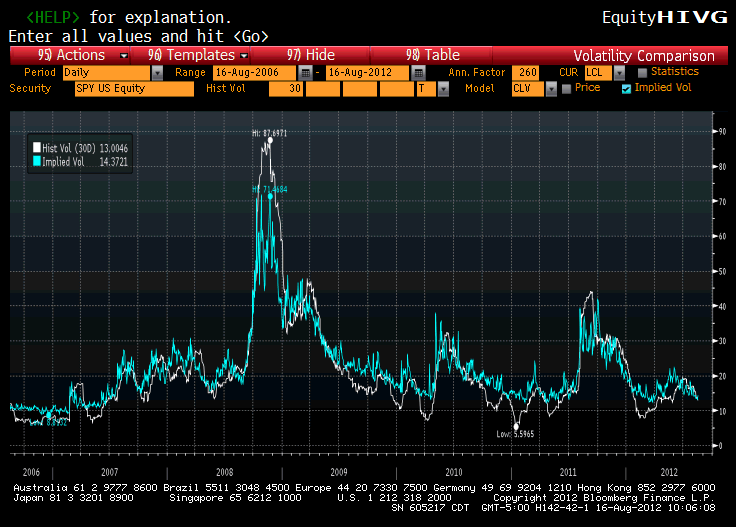
Since 1950, the annualized S&P500 volatility is 15.5%.  The one-day annualized volatility for the Aug SPY at-the-money options is 11% (i.e., expiring tomorrow). This is good news for Obama and the stock market. The chart below shows the implied vol in light blue, a 30-day actual trailing vol in white, from 2006-present.


Barry Ritholz links to a MarketTech report post that shows that VIX lows are good times to short the market (see below for VIX chart back to late 2011).  As the VIX and SPY are inversely correlated, this is really like saying that if you short the market at historical highs, it would be a good strategy.  The problem, of course, is that highs and lows are determined ex post.  In real time, it isn't clear the VIX is at a low.  For instance, the VIX stayed at this level from 1992-1995, and from 2004-06.  Just ask those who shorted USTreasuries at 'historic' lows  over the past 20 years.  

Wednesday, August 15, 2012

Muni Bond Exemption Benefits Issuers, Not Buyers

Brookings has an analysis of Romney's tax plan that asserts it won't consider the possibility of exempting the muni bond tax exemption because Romney has proposed to expand tax incentives on savings and investment. The assumption is that muni bond tax exemptions are obviously incentives for savings and investment, so Romney can't simultaneously say he's for savings and investment while proposing to cut the muni bond tax exemption.

It's hard to take serious a document that uses the phrase 'tax expenditure' vastly more frequently than 'tax revenue', but this claim that the muni bond tax exemption is consistent with helping savers is ludicrous. As muni bonds are a minor portion of total assets held by savers, the tax break does not go to the buyers but rather the sellers. In equilibrium, the expected return to investors--after tax--is equal among assets, so it doesn't create a deal for investors. That is, the adjustment in equilibrium is on the borrower side, in that they don't have to pay as much. The buyer gets the same after tax return.

 So much for savings, how about investment? Does anyone think states are not borrowing enough in the secular sense? I would think that most states have too much accumulated debt coming from perpetual deficits. If anything, dad needs to apply some tough love and tear up their credit card. Unfortunately, the Federal government is not so much like an adult dad, but rather, a teen mom from a dysfunctional reality show hoping to emulate Snooki's improbable payoff for being unapologetically stupid. We need more investment in stuff that increases productivity, not the redistribution (eg, payoffs to underfunded pensions) that dominates state expenditures.

Monday, August 13, 2012

Institutions Need More Shareholder Maximization

Joe Nocera wrote in last Friday's NYT that
Over time, “maximizing shareholder value” became viewed as the primary task of the corporation. And, well, you can see the results all around you. They’re not pretty.
For some reason, he thinks a profit maximizer maximizes short-term profits at the expense of longer term ones. Now, that's easy to see with hindsight applied to various trades we all should have made in 2007 (where were the NYTimes articles castigating easy mortgages prior to 2007?), but I would say that the private sector is much better at stopping things that have only good short-term effects than government. For example, only the government offers 3.5% down home mortgages, as if that idea really needs more data. Then there are regulators, who as Ted Gayer and Kip Viscusi point out, focus on their concerns to the exclusion of all others, so now we have an ethanol mandate that has the US creating fuel out of the most expensive carbohydrate to grow and process: corn.

I help coach my kid's wrestling and love watching it. It's a great sport for teaching those classic virtues of courage and discipline, and like hockey is more responsive to practice than sports like football and basketball that are more reliant on exceptional genetics. This year's Olympics were fun to watch because the two US champions both had signature moves they reached for repeatedly (for Jake Varner the ankle pick, for Jordan Burroughs the double leg). They highlighted a key to success is not being best at everything, but rather, having a specialty.  Another life skill.

Watching wrestling every 4 years at the Olympics is interesting because it keeps changing. For instance, this year there were two bronze medal winners in each weight. In 2004 Women's wrestling was added. There are now three separate periods, so scores are not cumulative (eg, you can win by having periods go 1-6, 1-0, 1-0). A five-point throw automatically wins a period.

But all these rule changes are pretty minor in big scheme of things, and very few of these rules made the sport that much better to watch (the tie-breaking rules are insanely lame). Olympic wrestling is still a niche sport because scoring is still too subtle, which makes it hard for outsiders to appreciate.

In contrast, mixed martial arts (MMA) has exploded over the past 20 years, mainly because the Fertitta brothers who run the largest MMA league are expert businessmen who understand both the sport and business. They are now billionaires, and have created a brand that competes with professional boxing.
The secret sauce has been competition, in that several MMA leagues developed (K-1, ExiteXC, Strikeforce, WEC), so the one with better excitement prospered. The basic product, human combat, is a perennial, so it was really about combining well-known sports (jiu jitsu, wrestling and boxing) into a single one.

Amateur wrestling is run by old men who aren't trying to get rich, and that's its problem. Interestingly, the profit motive didn't just create an incentive for more violence, but also greater safety, because they realized that nothing would damage the brand more than extreme injuries. In the first UFC bout in 1992 there were only three rules: no eye gouging, no biting and no groin strikes. Now there over 30 rules acquired through experience. For example, you can't kick someone in the head if they are on the ground, because this is a very dangerous strike.

Amateur wrestling is run by experts who try to satisfy many different stakeholders, is especially deferential to tradition, and is only weakly influenced by revenues.  MMA is run by businessmen trying to create something people want to watch, and success is the present value of bottom line profitability.  As in so many cases, the combination of profit seeking and competition is the optimal way to create a better product, which is the path to productivity growth.

Sunday, August 12, 2012

GMO Defends Equities Inconsistently

Pimco maven Bill Gross recently warned that both equities and bonds look headed for a bad intermediate future.  He makes the interesting observation that as labor income has declined over the past century, this allowed capital to reap more reward than what is merely in GDP growth (see chart below).  Yet, this cannot continue any more than bonds can appreciate from lower yields.  The result is pretty scary, because as Gross points out, a 4.75% asset return premium needs about a 7% growth from equities if bonds are going to generate 2% returns, and if this won't happen, CalPERS and many of its ilk are in serious trouble.


Ben Inker of GMO responded by noting two points. First, one doesn't see much relation from developed or developing countries between equity returns and GDP growth, over many decades. This is really interesting because most general equilibrium models of asset growth would show a relationship, and so to my mind this highlights the inappropriateness of 'Lucas tree models' for understanding the aggregate stock market. Equities should not be thought of as residual claims on an economy, but rather the peculiar returns to an asset class in a very complex equilibrium.


Consider the first-day returns on IPOs, which have averaged about 12% historically. This is obviously a huge return for those fortunate enough to get such shares, but unless you are Nancy Pelosi, or an investor who perpetually overpays for commissions, you don't get that one-day pop. That is, the investment banks capture this return by making investors overpay (or grant regulatory favors), so non-politicians don't capture any of this net net. The net money always goes to insiders, not passive investors, in hedge funds, corporate equity, corporate bonds, etc. Those big passive equity funds are like kids showing up to a trendy club and finding out that you need more than money to get in, you need connections, something unique to exchange.

As commissions and spreads have declined, the insiders are not making as much as they used to, so they can't afford to give away big returns to top-line stock indices. On top of low current long-term bond yields, this suggests weak equity returns going forward.

But then Inker returns to the intuitive theory of karma, and argues that equities have to generate a 6% real premium to compensate for the fact they are riskier than cash, noting their high volatility, and draw-downs during famously bad times like the Great Depression, WW2, and various financial crises. Yet it is pretty clear that risk is not correlated with higher returns within a variety of asset classes, such as equities, corporate bonds from BBB to C. Even GMO accepts this fact. Many people believe in a fundamentally inconsistent asset market: broad asset classes generate risk premiums that don't exist within these asset classes.

My solution, out in a book soon, argues this is because passive investing has zero risk premiums everywhere, when you look at assets in total. In any case, whether you believe in a large equity premium or not, there appears little reason to be in those highly volatile classes, unless you are like most people and overconfident about your stock picking abilities. This little conceit facilitates a rather large cluster-puck of mistaken assumptions, and I'm afraid most people will take the wrong lesson (eg, Joe Nocera's latest screed against shareholders), which if heeded will just aggravate our tendency towards more giant corporations with governmental influence, privileges, and resulting decreases in efficiency and competition. That will hurt GDP growth.

Thursday, August 09, 2012

Wrestling Starts Friday!

That is, men's freestyle.  Greco-Roman wrestling I find too subtle, witness Iran's heavyweight  defeating a Russian on a pretty weak move (a push out where he started on top). It's just a very strange way to wrestle, and the US got shut out to boot. Note America's best wrestlers (eg, Dan Gable, John Smith, Cael Sanderson) have all wrestled freestyle, because that is more like the American collegiate style.

 And don't get me started on women's wrestling, which I think is fine except it often gets equal space in big media outlets like Sports Illustrated or NBC, even though there are about 200 times as many male wrestlers or female soccer players per female wrestler, making the best women wrestlers not very elite relative to male wrestlers or your average female athlete.

Friday has the 55 and 74 kg divisions, Saturday the 60, 84 and 120 kg, and Sunday the 66 and 96 kg. The USA's best chance is 74 kg Jordan Burroughs at 13/8 odds, then 84 kg Jake Herbert and 120 kg Tervel Dlagnev at 8/1. (got the odds here). A weight class goes to completion in one day.

 I think Burroughs has raised Herbert's game, and really hope he can win because Herbert's a very personable guy who would be a good ambassador for the sport. Burroughs has been awesome lately, but everyone is good at that level (Denis Tsargush of Russia and Sadegh Goudarzi of Iran both could win).

 Michael Novogratz of Fortress helped raise some money, so American wrestlers will get $250k, $50k, and $25k for Gold, Silver, and Bronze medals.

update: Burroughs wins gold at 74kg.  Some Russian guy wins at 55kg.

America's Future

A good article on Argentina today in the WSJ.  They are a model of where I think America is going.  Lots of regulations and rights to stagnate the economy, lots of Keynesian demand management (ie, more government spending) by policy elites. You have private companies, but these are staffed at the top by government cronies.  If Stiglitz, Krugman or DeLong were put in charge, I'm sure this would be the result, regardless of their intentions.

Argentina didn't explode or stop working, it just slowly became less wealthy, and less free, so whereas 100 years ago they were similar to the US, now they are clearly backward.

Wednesday, August 08, 2012

Priorities over Enumeration

Science is about probabilities, not possibilities.  Many smart people don't appreciate this because logic  is often focused on what can be proved true or false, whether something is impossible, or possible.  There are very few 'existence' or impossibility theorems describing social phenomena that are interesting, mainly because it usually takes a pretty small adjustment in assumptions to negate the proof.  For example, I have not met anyone who thinks the first or second welfare theorem was compelling in developing their political beliefs.

In any case, I was struck by this notice of how America's latest psycho killer was on an FBI watch list, along with 420,000 others:
The FBI's apparently had Wade Michael Page on it's radar six years ago, he wound up killing six and injuring several others when he opened fire at a Sikh temple in Wisconsin. 
Figures released last fall put the FBI's watch list total at 420,000 -- including 8,000 Americans. But former deputy assistant director Danny Coulson says you can't watch everyone, even if they are an angry ex-military member with ties to white supremacist groups like Page reportedly was.
I imagine that list of 8000 Americans is pretty simple, they just looked at White Power groups and such. As most of these guys are just disgruntled, there's not much to do. A similar thing happened with the Colorado Batman shooter, where a psychiatrist notified the school the kid was troubled, but nothing was done, as usual.

A major problem with risk management is large organizations are very good an enumerating improbable risks, not so good at priorities.  That's because collectives often lose their common sense when they become a certain size, where those downstream often get little feedback, and so they simply create reports that highlight measurables--enumeration of risk--and their bosses accept this because they too are clueless and have little intuition.  Incompetent managers are a cancer, and they metastasize.  These are inevitable inefficiencies of scale, why the Too-Big-Too-Fail banks don't outperform smaller ones even with their taxpayer funded bond guarantee.

Large organizations should not so much focus on preventing these risks, but rather containing them via a quick response. Knight's initial mistake last week is understandable, stuff happens, but the delayed response--even the NYSE called after only 5 minutes to tell them they had a bug and it took them another 25 minutes to pull the plug--suggests a more profound problem.  

Tuesday, August 07, 2012

Tax Breaks for Olympians?

Even Obama seems to be for giving Olympians tax breaks on their medal income.

Olympians work hard, but there's always an element of luck too. Others derive benefits from their performances, and these champions all rely on the support of others. Thus, it's just like any other income in principle.

No wonder mentions of eliminating tax loopholes usually go nowhere once a politician gets in office.  Tax breaks for popular demographics and projects seem a costless way to do good and win favor.

Monday, August 06, 2012

Bankruptcy, Please

While banks are still being persecuted for lending too much and not lending enough, too many still are getting money they shouldn't.  Case in point, a San Diego school district
In 2008, voters had given the district permission to borrow more money to finish its modernization, and they had received a big promise from the elected school board in return: No tax increases.
.. the district got creative. 
With advice from an Orange County financial consultant, the district borrowed the money over 40 years in a controversial loan called a capital appreciation bond. The key point for the district: It won’t make any payments on the debt for 20 years. ... 
"We could have authorized more taxes, it would just have been breaking the promises we made to the community," said school board member Todd Gutschow.
This works great if you plan on dying within 20 years, but otherwise it's not very smart. As Reason writers Veronique de Rugy and Nick Gillespie write in The Hill, neither party is working honestly to tackle the nation’s fiscal issues, in large part because it doesn't sell to voters. I see a train wreck, and so the sooner it happens the less disastrous it will be.

Sunday, August 05, 2012

The Bubble's Essence

Paul Willen is a research economist at the Federal Reserve Bank of Boston. His big idea is that the key to the recent 2008 bubble was that people assumed housing prices couldn't fall. Everything else really follows from that.

 Lots of parties exacerbated the crisis by encouraging unqualified buyers to receive mortages: investors, regulators, underwriters, politicians, homebuyers, non-profits, academics. None were sufficient, all necessary.  If Willen is correct the focus shouldn't be on these parties, guilty as they are, but rather, why it was conventional wisdom that housing had little aggregate year-over-year price risk. If we understand that question better it might be more fruitful than other correctives, because if everyone thinks an asset has zero risk, it seems probably that it will become risky (eg, see my Batesian Mimicry post).

Just getting people to agree this was the conventional wisdom would be a great service, and I think academically feasible to demonstrate. With hindsight, fewer and fewer admit to thinking housing collateral had no risk.  Others suspect that those who thought housing would rise forever were simply evil and self-interested, like Goldman's Fabrice Tourre. I think that narrative is highly misleading.  

Saturday, August 04, 2012

Not Swearing

Roy Baumeister wrote a wonderful book on the benefits of self-control, or discipline. He notes self-control is one of the most important traits in predicting success in life, good relationships, earning more money, being successful in your field, staying out of jail, even living longer. It's the foundation for morality and moral behavior. It is one of the more important factors in a person's success, and unlike IQ very amenable to training. Here he notes the benefits of practicing self-control, including not swearing, and so like a muscle, willpower improves with practice:


In contrast, here's beatnik poet Allen Ginsberg, arguing that restrictions on swearing inhibit communication, even morality:


 I think not swearing is a good habit. Further, when used rarely, it retains emphasis for those various times you really want to communicate urgency or importance.

Thursday, August 02, 2012

Israeli's Advantage Over Palestine: Not Culture!

One of the greatest stars in modern economics is Darron Acemoglu (right picture), who wrote Why Nations Fail with Harvard political scientist James Robinson. Commenting on Mitt Romney's quip that Israel has a more productive 'culture' than Palestine, Robinson notes: "Mitt is confused." The article interviews these experts who point out the true culprits: human capital, institutions, elites, and government corruption.

That's academic insight for you. In their minds, culture has nothing to do with human capital, elites and institutions, which as post-colonial Africa demonstrated, are pretty much exogenous (joke!). No wonder 'young stars' say things like 'firms seem to be unproductive in large part because of bad management.'

Of course, these were the guys that admitted they had no clue why the Dominican Republic has outperformed Haiti over the past century. I say macroeconomists should not expect to be taken seriously as scientific specialists until they come to a consensus on that, because if they can't explain the past on a case that has a 5-fold income differential, why should I expect them to predict things that will add or subtract 1% from GDP growth next year?

Mortgage Follies Circa 1994

I was browsing the web and came across this video about NACA, an Acorn-type organization that seems manaically focused on lowering mortgage costs to poor people. Mission accomplished! Making houses 'affordable' created the no-doc, no-downpayment debacle, yet their take is clearly that anything that lowers the borrower cost of mortgages is good.

Yet even within their puff-piece video, they boast about fighting predatory lending by forcing a bank to allocate $8B towards 'affordable loans' back in 1994. They seem totally unaware this might have contributed to the problem (it's just a 12 second clip):


When these loans eventually couldn't be paid because the collateral value stopped rising, their solution was to get the banks to write down the mortgages. Now, it's only the government giving mortgages to such people, a solution that isn't helping the housing industry. The key to creating persistent dysfunctional redistribution plans is to make them so big alternative narratives for its inevitable failure are defensible.