If the standard asset pricing model is correct, we estimate expected returns from risk premiums and their factor loadings (eg, beta*equity return premium), and we can infer the risk loadings and risk premiums from an expected return. Given we don't observe expected returns, but assume that with large samples, average returns estimate expected returns, this is why the small cap risk factor is supposed to exist, because it tautologically explains the higher return to small cap stocks over large cap stocks. In this way there should be a risk-return duality from expected return to risk.
There has been a long tradition in Western thought of trying to develop a set of beliefs that are objectively true and rational. This usually involved some basic assumptions and then logic, as in dialectical materialism, or Russell and Whitehead's Principia Mathematica. It is very comforting to think that important beliefs are can be rationally justified, in contrast to beliefs based on faith or aesthetic preferences. When finance created asset pricing theory in the 50's and 60's, this kind of rational reductionism was dominant, and it seemed obvious that applying the logic would render previously intractable, qualitative problems into unambiguous solutions within linear programming or dynamic programming. Expected returns in this framework have a rational, objective grounding, a la Logical Positivism. Alas, out investment beliefs is just like our other beliefs, and it is futile to try and make them apodictic.
ProShares has revolutionized trading with their plethora of levered funds that provide 2 times the daily return of some target index, such as the SSO ETF which replicates a strategy that generates 200% return of the S&P500 index over a single day. These ETFs are very popular, and obviously have the precise doubling or tripling of the covariance as the targeted index. Yet, due to trading costs and compounding, the returns over longer periods are significantly lower than 2 times the return on the index. Of the 24 ETFs that promise a 200% daily return of the index, where the index has risen since the end of 2009 through August 2011, the average Ultra ETF has returned about 10% less than 2 times the index. If returns are a function of covariances, investors are being shortchanged here, and the ETF should trade at a discount to net asset value, but they don't.
Imagine a world where expected returns are solely a function of covariances, as standard theory implies. Then if you create assets with specific covariances, the market should give them specific expected returns. Everything should be consistent. People should expect risk and return to be positively correlated.
Instead, Sharpe and Amromin find that people expect volatility and returns to be inversely correlated: when they are bullish they expect low volatility, and when they are bearish they expect high volatility. This is counter to standard theory, where basically expected equity returns should be a linear function of market variance. Given the inverse correlation between returns and volatilities, where increases in stock prices correspond to decreases in implied volatilities and vice versa, this makes sense. People are clearly assuming a specific return, and then deriving the volatility consistent with that scenario.
For buyers this means they expect volatility to decrease as the price rises, as it does in practice (and is implicit in the volatility skew in equity options). It is not possible to expect a really large expected return without assuming a large amount of risk, merely because it necessarily follows that if you expect, say, a 20% return on an asset, it must be capable of generating a fluctuation that high, which unfortunately also implies it could fall by 20%. The conditional volatility on an asset where a relatively large return is significantly probable must be larger than for an asset where a relatively large return is less common. Expected returns are a function of expected volatility (higher volatility assets have higher conceivable returns), but they are collectively wrong, which is why future returns are decreasing as a function of volatility.
Investors understand that stocks prices fluctuate randomly, but just as 'no conqueror believes in chance,' no active investor believes in chance either when they take risk. People are thinking about the collapse of the wave function, as opposed to the wave, because it’s more common for investors to think about outcomes as opposed to probability distributions. They understand they can be wrong, and experience much anxiety about their investments, but that's different than thinking that expected returns are random, and very few investors base their expected return on risk factors and their loadings, as opposed to some specific outcome.
There is a duality, but it involves two sets of expected returns. If people invest based on the delusion that their expected returns are single outcomes, they are constantly evaluating value. Many investors are making this work, investing by applying some discounted cash flow logic. They are sufficiently right that a stock price is a decent estimate of its future profitability, but sufficiently wrong so that the stocks with the greatest expected variances, which necessarily include those stocks with the greatest expected returns among its investors, tend to be most 'over-bought', and thus have the lowest returns. Expected returns, derived from a model that empirically estimates expected returns from historical returns, as opposed to canvassing investor opinion, are negatively related to risk. Low volatility investing is truly outside-the-box, an expectation that comes from noting the emergent pattern caused by investor beliefs, which contain a systematic bias.
Sunday, September 25, 2011

Thursday, September 22, 2011
UBS Staffed by Idiots

Perhaps the aristocratic heritage of Swiss banking has generated their version of Charles II of Spain. That's the poor, misshapen sap to the right with only 2 great-great-great-great grandparents, a family tree that converges.

I wrote a rather fawning post complimenting UBS on their candor and perception when the wrote up their 2008 debacle. They seemed to have identified key errors in judgment, and were refreshingly detailed in the origin of their write-down (I never saw anything similar among US banks). Everyone slips up now and then, and so I figured that was a sign of a healthy organization that merely made a singular mistake.
However, 2 strikes and you are out. Reading snippets about their $2B loss via some low-level trader makes me think the bank is thoroughly incompetent. This 'Delta One' desk had a $7B rogue trader loss only a couple years ago, so they should have been keenly aware of the potential risks (this was at Soc Gen--the businesses have the same Delta One name for some reason). To generate that kind of loss implies several levels of fail within risk management, the trading desk itself, and the back office. It's easy to think a couple people screwed up, but this must have involved at least a dozen important people who apparently got paid to surf the web all day.
When I worked for a large bank there were many senior executives who were good at playing the game, but ultimately ignorant of how banks made money. These include those who were good at glad-handling the various political bodies that were essential to many of our strategic efforts, such as what businesses we could enter, and keeping competitors out under the pretext of protecting the consumer. Unfortunately, as $115MM Citigroup executive Bob Rubin showed, such skill doesn't translate in an ability or even interest in nitty gritty issues like what's on the balance sheet. A smart banker avoids positions unrelated to the core business of originating and distributing loans and deposits and other financial instruments. For example, it does not make sense to trade corn futures if you have no business with futures exchanges or corn growers.
I used to think the Swiss financial types were smart, with their solid currency and all. Perhaps they merely avoided both World Wars, which could have been due to savvy strategy, but also chance. They seem to have good general competence (thus the nice mea culpa on their 2008 write-down), but are too aloof or naive for the realities of modern banking. They should stick to chocolate.
Wednesday, September 21, 2011
Credit Suisse Arb Index Fishy
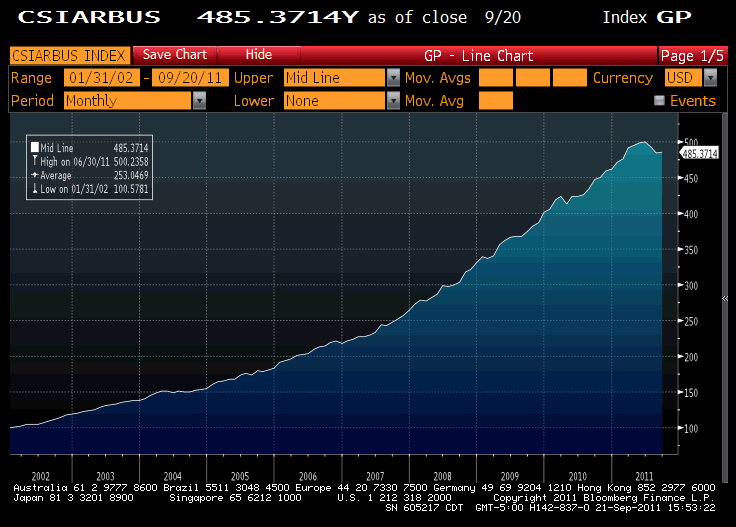
Credit Suisse has an 'Arbitrage US Index' (CSIARBUS Index), that presumably reflects the return on 10 stat arb strategies. The total return since inception in Jan 2002 is above. It's a Sharpe of about 2.4, Madoff-like. If it's real, everyone should put most of their money in such strategies asap.
I'm rather skeptical of such indices. Where's the infamous August 2007 draw down? The index was first made available on Bloomberg in February 2011, and just this August this index had its worst draw-down ever. I have a feeling it is filled with innumerable back-fill biases, a typical naive backtest quants present all the time, oblivious to their selection biases. I looked on the internet for some kind of description, and found nothing.
The world doesn't need more institutions presenting implausible returns. It sure doesn't help their credibility.
Tuesday, September 20, 2011
Keynesian Anecdote
From Ron Suskin's book on Obama:
The focus on jobs irrespective of whether they pass a cost-benefit test, highlights the worldview of Keynesians, where spending on anything when unemployment is high, is a good thing via the magic of the multiplier. Further, spending $100k per job is good because it's a million jobs. One wonders if there's a price at which it would not be attractive.
By the estimates of [Christina Romer's] Council of Economic Advisers, at a cost of $100,000 per job, $100 billion would mean one million new jobs. "A million people is a lot of people."
Obama was unenthusiastic. Romer, in meeting after meeting, came back with new plans, new ways either to locate $100 billion or pitch it to Congress. Her appeals were passionate. She said they were falling into a "The perfect is the enemy of the good" trap. It's about doing something, anything."
The focus on jobs irrespective of whether they pass a cost-benefit test, highlights the worldview of Keynesians, where spending on anything when unemployment is high, is a good thing via the magic of the multiplier. Further, spending $100k per job is good because it's a million jobs. One wonders if there's a price at which it would not be attractive.
Monday, September 19, 2011
Obama to Lower Interest Expense by $430B?
Sunday, September 18, 2011
Is Low Vol Investing a Value Play?
Dimensional Fund Advisors, the embodiment of conventional wisdom for rational academics, has a paper out--Understanding Low Volatility Strategies: Minimum Variance, by Ronnie R. Shah--arguing that low volatility funds are basically value and industry plays in disguise (I can't find it on the web, so I won't post it, but it seems like a standard white paper for public consumption). It's really a spin on Berd Scherer's white paper from last year, inspired by Dan DiBartolomeo's 2007 PowerPoint, that the value stocks are driving low volatility's seeming alpha. Both of these papers devolve into convoluted arguments certain to rationalize the CAPM framework, but instead are just squid ink. DiBartolomeo states that the value premium is primarily just a return to negative skew, which investors dislike and thus demand a premium.
The skew explanation for anomalies is plausible at 30,000 feet, but find this line of reasoning rather unserious, as when Nassim Taleb pals around with Danny Kahneman, one arguing that we are primarily prefer positive skew (Kahneman), the other negative skew (Taleb), and they happily consider themselves brothers in arms. It's like anarchists and fascists united against the status quo, which would excusable if they were not also happily convinced they are more alike than different.
The negative skew premium may exist, but then one would have to then explain why equities are generally thought to have higher returns than corporate bonds, even though clearly bonds have much greater negative skew than equities. And just look at the histogram of monthly returns for the market, size and value factors (from Ken French's website). I don't see how value is considered to have negative skew.

Lastly, Post and van Vliet (2006) showed that if you actually look at utility functions where investors care about variance AND skew, the maximum skew premium is a fraction of the 'variance premium', about one-fifth as large. This is because investors still must be globally risk averse, and since skew and variance are positively correlated, there are limits on how large the skew aversion can be relative to the variance aversion.
Scherer notes that if you construct a minimum variance portfolio a certain way, and regress it against the 3 Fama-French factors (market, size, and value), as well as long-short portfolios formed on betas and residual variance, much of the MVP's performance is 'explained'. Now, given MVPs load up on low beta and low residual risk stocks, it's obvious that a long-short portfolio formed on CAPM betas and residual variances would explain the MVP return relative to the broader index, but that's really not interesting. It's a bit like saying the book/market effect explains the price/earnings effect.
The DFA's Ronnie Shah, meanwhile, is much clearer, but makes the same point. He notes that the return premium to value and the market is about 4% for both. As the market beta on his MVP portfolio is about 0.75, and his beta on value is about 0.25, it seems like a swap of market exposure for value exposure.
It could be, but I'm skeptical for two reasons. First, as Daniel and Titman 1997 noted, the return to 'value' is more a function of it's characteristic, low book/market, than its 'factor loading', which in the case of value is merely a loading on itself. Houge and Loughran found that mutual funds with high value loading, independent of whether or not it was a 'value fund', had no explanatory power. The value risk factor is really just the value anomaly rebranded as a risk factor, because it isn't obviously 'risky' in any sense. Originally it was thought value was related to financial distress, but then when we look at distress directly, such as using agency ratings or metrics of default based on income statements and balance sheets, distressed firms actually have lower-than-average returns. So I'm skeptical value is anything but a characteristic-based anomaly, not a 'risk factor'.
Secondly, when I look at the Minimum Variance and Low Beta portfolios I have created, I do not see a consistent value loading. Looking at the MVP, which I have data from 1998 to 2011, it estimates value beta of 0.34 using monthly data. Using daily data from July 2000 through July 2011, the value beta is 0.24. These are around what Shah gets. Yet it floats around like an incidental symptom, not something fundamental. Here's the data for my MVP and Beta 0.5 portfolios using daily data (value beta being a loading on the Fama-French HML value factor proxy):

Here it is using the longer monthly time series:

While on average, the value beta may be around 0.3, it doesn't seem consistent enough to be fundamental.
Now, Shah does note that low vol portfolios tend to have a lot of utility loading, and little technology. True. But I've never seen someone argue that various industries have higher risk than others. Looking at industry relative returns, one three-year period over the prior, there is no pattern. That is, past winners do not repeat consistently, as they would if there were an industry risk premium. So, to say this is picking up the 'utility' risk premium, and avoiding the 'tech' insurance premium, does not make sense. Of course, the higher-weighted utility industry has much lower volatility than the lower weighted tech industry, and so if there was a risk story here, it would take some special pleading.

Dimensional's reluctance to embrace low volatility investing is good news to low volatility investors. As long as people generally keep doing what they have done, the opportunity remains to simply improve one's index returns by focusing on the low volatility subset of stocks, lowering volatility and increasing the return. It's the easiest, large-scale way to better institutional returns since the invention of the index fund.
The skew explanation for anomalies is plausible at 30,000 feet, but find this line of reasoning rather unserious, as when Nassim Taleb pals around with Danny Kahneman, one arguing that we are primarily prefer positive skew (Kahneman), the other negative skew (Taleb), and they happily consider themselves brothers in arms. It's like anarchists and fascists united against the status quo, which would excusable if they were not also happily convinced they are more alike than different.
The negative skew premium may exist, but then one would have to then explain why equities are generally thought to have higher returns than corporate bonds, even though clearly bonds have much greater negative skew than equities. And just look at the histogram of monthly returns for the market, size and value factors (from Ken French's website). I don't see how value is considered to have negative skew.

Lastly, Post and van Vliet (2006) showed that if you actually look at utility functions where investors care about variance AND skew, the maximum skew premium is a fraction of the 'variance premium', about one-fifth as large. This is because investors still must be globally risk averse, and since skew and variance are positively correlated, there are limits on how large the skew aversion can be relative to the variance aversion.
Scherer notes that if you construct a minimum variance portfolio a certain way, and regress it against the 3 Fama-French factors (market, size, and value), as well as long-short portfolios formed on betas and residual variance, much of the MVP's performance is 'explained'. Now, given MVPs load up on low beta and low residual risk stocks, it's obvious that a long-short portfolio formed on CAPM betas and residual variances would explain the MVP return relative to the broader index, but that's really not interesting. It's a bit like saying the book/market effect explains the price/earnings effect.
The DFA's Ronnie Shah, meanwhile, is much clearer, but makes the same point. He notes that the return premium to value and the market is about 4% for both. As the market beta on his MVP portfolio is about 0.75, and his beta on value is about 0.25, it seems like a swap of market exposure for value exposure.
It could be, but I'm skeptical for two reasons. First, as Daniel and Titman 1997 noted, the return to 'value' is more a function of it's characteristic, low book/market, than its 'factor loading', which in the case of value is merely a loading on itself. Houge and Loughran found that mutual funds with high value loading, independent of whether or not it was a 'value fund', had no explanatory power. The value risk factor is really just the value anomaly rebranded as a risk factor, because it isn't obviously 'risky' in any sense. Originally it was thought value was related to financial distress, but then when we look at distress directly, such as using agency ratings or metrics of default based on income statements and balance sheets, distressed firms actually have lower-than-average returns. So I'm skeptical value is anything but a characteristic-based anomaly, not a 'risk factor'.
Secondly, when I look at the Minimum Variance and Low Beta portfolios I have created, I do not see a consistent value loading. Looking at the MVP, which I have data from 1998 to 2011, it estimates value beta of 0.34 using monthly data. Using daily data from July 2000 through July 2011, the value beta is 0.24. These are around what Shah gets. Yet it floats around like an incidental symptom, not something fundamental. Here's the data for my MVP and Beta 0.5 portfolios using daily data (value beta being a loading on the Fama-French HML value factor proxy):

Here it is using the longer monthly time series:

While on average, the value beta may be around 0.3, it doesn't seem consistent enough to be fundamental.
Now, Shah does note that low vol portfolios tend to have a lot of utility loading, and little technology. True. But I've never seen someone argue that various industries have higher risk than others. Looking at industry relative returns, one three-year period over the prior, there is no pattern. That is, past winners do not repeat consistently, as they would if there were an industry risk premium. So, to say this is picking up the 'utility' risk premium, and avoiding the 'tech' insurance premium, does not make sense. Of course, the higher-weighted utility industry has much lower volatility than the lower weighted tech industry, and so if there was a risk story here, it would take some special pleading.

Dimensional's reluctance to embrace low volatility investing is good news to low volatility investors. As long as people generally keep doing what they have done, the opportunity remains to simply improve one's index returns by focusing on the low volatility subset of stocks, lowering volatility and increasing the return. It's the easiest, large-scale way to better institutional returns since the invention of the index fund.
Friday, September 16, 2011
The Big Lie
The KIPP education group has been trying to sell some character values to its students:
Now, if on average the poor possess an equivalent amount of most virtues--discipline, generosity, prudence, etc.--then there's a massive and subtle conspiracy of DaVinci code proportions going on. Virtues by definition make us prosperous, statistically. The idea that the poor are so insecure that they have to be told an obvious untruth to maintain their self-esteem merely creates more resentment against society, which they are told again and again is fundamentally unfair in a really subtle pervasive way. The truth, or something close to it, is necessary for finding the good, and that means telling kids they need bourgeois values. If someone points out that such values are more like 'middle class values' than 'public housing values', the kinder might actually appreciate the connection between these abstract concepts and concrete results.
What appealed to Levin about the list of character strengths that Seligman and Peterson compiled was that it was presented not as a finger-wagging guilt trip about good values and appropriate behavior but as a recipe for a successful and happy life. He was wary of the idea that KIPP’s aim was to instill in its students “middle-class values,” as though well-off kids had some depth of character that low-income students lacked. “The thing that I think is great about the character-strength approach,” he told me, “is it is fundamentally devoid of value judgment.”
Now, if on average the poor possess an equivalent amount of most virtues--discipline, generosity, prudence, etc.--then there's a massive and subtle conspiracy of DaVinci code proportions going on. Virtues by definition make us prosperous, statistically. The idea that the poor are so insecure that they have to be told an obvious untruth to maintain their self-esteem merely creates more resentment against society, which they are told again and again is fundamentally unfair in a really subtle pervasive way. The truth, or something close to it, is necessary for finding the good, and that means telling kids they need bourgeois values. If someone points out that such values are more like 'middle class values' than 'public housing values', the kinder might actually appreciate the connection between these abstract concepts and concrete results.
Wednesday, September 14, 2011
Bogle's Beginnings

John Bogle is one of the founders of index investing, a very valuable tool still underutilized by investors. Bogle writes over at the WSJ:
The idea that passive equity management could outpace active management—then the mutual fund industry's universal strategy—was derogated and ridiculed. The fund, now called the Vanguard 500 Index Fund, was referred to as "Bogle's Folly." Yet today indexing has come to dominate the field. Over the past five years, index funds have accounted for 100% of all equity funds' cash flows, with assets now totaling $2 trillion, one-fourth of all equity fund assets.
The story is a good one. In 1951, the anecdotal evidence John Bogle--a mediocre student at Princeton--assembled in his senior thesis on the then-minuscule mutual fund industry led him to write that mutual funds “can make no claim to superiority to the market averages.”
In 1975 Vanguard was a shareholder-owned mutual fund group—the company was owned by the mutual fund investors—so low-cost fund administration was not taking money from owners, it was giving money to them. In contrast, the idea of an index fund would have hardly appealed to a high-cost fund complex whose very revenue depended on the conviction that active management did add value, at least, in their particular case.
In his pitch to the Vanguard board for starting an index fund, he brought some of his own data on the performance of mutual fund managers, suggesting that they underperformed by about the same amount as their expenses, and some references to recent articles by Paul A. Samuelson and Charles Ellis. So, blessed with some good intuition from Bogle, the rising popularity of the idea in the academy, timing, and good incentives from Vanguard, they had both the opportunity and the motive to create the first retail index fund, which is now the largest index fund in the world, and Vanguard, the second-largest fund family. By the next summer, the fund was launched with about $11 million.
While Bogle seemingly had the idea right all along, it should be noted that there were several missteps among the index founding fathers. John McQuown and David Booth at Wells Fargo, and Rex Sinquefield at American National Bank in Chicago, both established the first passive Index Funds in 1973. These were portfolios targeted at institutions. The Wells Fargo fund was initially an equal-weighted fund on all the stocks on the NYSE, which, given the large number of small stocks, and the fact that a price decline meant you should buy more, and at a price increase sell more, proved to be an implementation nightmare.
It was replaced with a value-weighted index fund of the S&P500 in 1976, which eliminates this problem. Another misstep was clearly not targeting the retail investor early, which turned out to be where the real money was. Rex Sinquefeld and David Booth started Dimensional Fund Advisors in 1981, in part to address this deficiency. Sinquefeld was also hooked into the University of Chicago, which had Eugene Fama as its head of research. As the size effect was the hot thing at that time, DFA had a small cap portfolio at the outset to take advantage of this anomaly. Unfortunately, the size effect disappeared in the 1980s, but Dimensional was able to survive this setback admirably. Thus, even a great, simple idea like an index fund, has a learning curve in practice.
Even good ideas like index funds are not straightforward, and take some interested care to make work. Further, as John Bogle showed, it was not until he was the CEO of a fund complex that he could implement his idea for a retail index fund, and even then he dealt with a skeptical board, and relied heavily on authority figures like Paul Samuelson (Sinquefeld and McQuown were also well-connected). Imagine if he were a bright-eyed young kid with merely a PowerPoint presentation and his own data. It is essential to have the right connections when you have a good idea, more so the bigger the idea.
Tuesday, September 13, 2011
Why Government Spending is So Impotent
We have a proposed Southwest Light Rail Transit line, a high frequency train that would connect downtown Minneapolis to my town of Eden Prairie. funding for capital costs will come from four sources: the transit sales tax in the metro area (30 percent), the County (10 percent), the State (10 percent), and the Federal Transit Administration (up 50 percent). Every month there's a new cost added to the currently estimated $1.25 billion project.
Ridership is projected to be 24,000 to 30,000 rides per day by year 2030, which would be a large increase from the 2000 rides a day generated via the buses that run from Eden Prairie to downtown. Currently, very cushy buses with large comfortable seats carry a handful of people downtown all day on each trip. Revenue, meanwhile, is falling, reflect low demand. Riders pay an average of $2.5 per trip, even though it costs $8 to cover marginal costs. The proposed project has many stops as planners hate express routes that travel nonstop node-to-node because this just encourages riders to live outside the city! The wishful thinking is basically designed to fail, not that anyone cares because they are all spending not just someone else's money, but each agency feels like the other agencies are subsidizing them, as if it doesn't all come from taxpayers in the end.
Spending money on such boondoggles to create jobs relies on a faith in the fiscal multiplier, and the magic of spending to reduce debt. Bush II spent like a drunken sailor (wars, medicare) and this ended with a disaster even though it should have been no worse than the alien invasion expenditures suggested by Keynesian economists. It should be remembered that after independence India focused on jobs and the poor, as opposed to free trade and property rights, and they stagnated for decades. If governments could boost the economy spending on big top-down projects, countries like India would have done much better than countries that were less hands-on in their management.
Ridership is projected to be 24,000 to 30,000 rides per day by year 2030, which would be a large increase from the 2000 rides a day generated via the buses that run from Eden Prairie to downtown. Currently, very cushy buses with large comfortable seats carry a handful of people downtown all day on each trip. Revenue, meanwhile, is falling, reflect low demand. Riders pay an average of $2.5 per trip, even though it costs $8 to cover marginal costs. The proposed project has many stops as planners hate express routes that travel nonstop node-to-node because this just encourages riders to live outside the city! The wishful thinking is basically designed to fail, not that anyone cares because they are all spending not just someone else's money, but each agency feels like the other agencies are subsidizing them, as if it doesn't all come from taxpayers in the end.
Spending money on such boondoggles to create jobs relies on a faith in the fiscal multiplier, and the magic of spending to reduce debt. Bush II spent like a drunken sailor (wars, medicare) and this ended with a disaster even though it should have been no worse than the alien invasion expenditures suggested by Keynesian economists. It should be remembered that after independence India focused on jobs and the poor, as opposed to free trade and property rights, and they stagnated for decades. If governments could boost the economy spending on big top-down projects, countries like India would have done much better than countries that were less hands-on in their management.
Monday, September 12, 2011
Sunday, September 11, 2011
Stock Returns by Debt Rating
 Above are annual returns for portfolios formed every July 1, based on the Senior rating of the company. I only used non-financial companies because financial companies tend to be only with investment grade, and they are very different from a debt rating perspective (when I modeled default at Moody's, there was a clear non-financial focus because financial companies are very different).
 The annual data are as follows for this period (Jul1975-Jun2011):
| StockReturns(%) | beta | Volatility(%) | |
| AAA | 12.4 | 0.78 | 17.1 |
| AA | 13.9 | 0.81 | 16.1 |
| A | 14.3 | 0.81 | 16.5 |
| BBB | 14.2 | 0.82 | 17.9 |
| BB | 15.0 | 1.04 | 23.4 |
| B | 8.6 | 1.43 | 32.0 |
| C | -12.7 | 1.18 | 44.9 |
It appears there's a reasonable story one could tell about returns from AAA to BB: higher returns, and higher intuitive measures of risk: beta, volatility. But for B and C rated stocks, the returns make no sense to standard asset pricing theory, because these are obviously risky stocks. I remember presenting this chart to an NBER conference around 2000, and the esteemed audience told me I was wrong; my data had to be incorrect. I was working at Moody's, so my ratings data was as good as it got. Anyway, I wrote it up and sent it to Journal of Portfolio Management, and the editor, Peter Bernstein, wrote back they weren't accepting submissions at that time. I thought that was an odd response. This avenue wasn't part of my day job, so I let it go, but I keep updating my data for fun.
The result is really corroborated by Campbell, Hilscher and Szilagyi (2005), who found distress risk to be negatively correlated with stock returns, which makes sense because volatility and leverage is inversely correlated with future returns, and cash-flow is positively correlated with future returns, so those are the main drivers of default risk.
Reality is that which, when you don't believe it, doesn't go away, so I don't really mind when people tell me I'm wrong on facts like this.
Saturday, September 10, 2011
This is not Our Day

On September 11 2001, there were many individual acts of unambiguous courage, a primal virtue. As the instigators had no reasonable end to rationalize their means, the moral calculus was very simple that day. Everyone dying stoically or risking death to save others was a courageous person, and other than the terrorists all those who died were innocent victims.
I knew one person who died that day, Brit Oliver Bennett, a real mensch, but as I worked at Moody's and took the daily stop at the World Trade Center to get to work, when I see the documentaries it really makes me tear up thinking about the horrible ending to people so 'close' to me.
Physical courage is admirable, but in modern society it simply isn't as important as it was when philosophy developed 2500 years ago. Intellectual courage, the readiness to risk humiliation, is much harder, precisely because it is more ambiguous. Only with the virtue of hindsight of generations do we see intellectually courageous stands for what they were, what distinguishes the Churchills from the Maos, the Galileos from the Lysenkos. It is courage combined with prudence, not mere zealotry.
Having something terrible happen to you generates instant sympathy. Our culture has moved from from celebrating accomplishment (Eisenhower) to suffering (McCain), where suffering has been expanded to include the indignity of growing up a non-asian minority. Thus, Obama's rather cushy Hawaiian life was transformed in his autobiography into something subtly oppressive because his biological father was African.
I think it's fine to remember that many people were virtuous on that day, but statistically it occurs among millions of people who get up day after day, without complaining, and suffer indignities and physical inconvenience doing a job they are overqualified for, primarily to provide for their families. Let's not make random victimization the new template for heroes and holidays.
Friday, September 09, 2011
Unions of Peace
Joe Biden, Labor Day:
From the NYT yesterday:
von Mises noted that unions were based on coercion and monopoly, sources of inefficiency and simple injustice in most scenarios, but, they're populist, so it's always tempting to rationalize them in some way.
"We've been through a lot of fights, but this is a different kind of fight," he told an annual Labor Day gathering of the Cincinnati AFL-CIO. "This is a fight for the heart and soul of the labor movement. This is a fight literally for our right to exist. Don't misunderstand what this is. … You are the only folks keeping the barbarians from the gates."
From the NYT yesterday:
About 500 longshoremen stormed the new $200 million terminal in Longview before sunrise Thursday, carrying baseball bats, smashing windows, damaging rail cars and dumping tons of grain from the cars, police and company officials said.
von Mises noted that unions were based on coercion and monopoly, sources of inefficiency and simple injustice in most scenarios, but, they're populist, so it's always tempting to rationalize them in some way.
Thursday, September 08, 2011
Why I'm Pessimistic
Last month, a big deal was made about a deal to raise the debt ceiling, which involved a major concession by Obama: $917 billion in spending cuts over 10 years. A special committee of lawmakers would be charged with finding another $1.5 trillion in deficit reduction, which could come through a tax overhaul and changes to safety-net programs. That included only $22B in fiscal 2012.
Tonight, Obama just added about $100B in spending for FY2012, as well as tax cuts and more spending in future years. Next time there's a debt ceiling stalemate, Obama should promise to cut spending by $10 trillion in future decades.
Tonight, Obama just added about $100B in spending for FY2012, as well as tax cuts and more spending in future years. Next time there's a debt ceiling stalemate, Obama should promise to cut spending by $10 trillion in future decades.
Wednesday, September 07, 2011
Risk and Return: Knowledge is Dangerous
From Yoav Ganzach, Judging Risk and Return of Financial Assets (2001).
So, when judging familiar stocks, analysts' judgments of risks and returns were positively correlated, as conventionally predicted. But when judging unfamiliar stocks, analysts tended to judge the stocks as if they were generally good or generally bad - low risk and high returns, or high risk and low returns. Ganzach presents some surveys, testing a bunch of MBAs familiar with the CAPM. He basically argues that when people really understand an asset, they then apply the standard CAPM reasoning (expected return inversely related to risk), and worked backward from the intitial 'good asset' to 'low return' (or from 'bad' to 'high'), using their theoretical training. The author assumed without much note the CAPM theory as correct. I see it as applying a theory that is severely contradicted by the data, solely because it is so well believed by conventional wisdom.
These students would have been better off in a state of ignorance. Empirically we know that high cashflow and low volatility are correlated with higher-than-average returns, but there's no dominant theory for that.
Ganzach's 'unfamiliar asset' finding is what Sharpe and Amromnin found in general surveys of American investors that when they believed times were propitious for stocks, they would have high returns and low risk. Forecasting the overall market is something difficult for anyone, so individuals would likely behave as if this were an 'unfamiliar' asset play.
But with some knowledge of the situation, one sees the particulars which are invariably mixed: everything has pros and cons. To see a pattern within this overload of data requires a theory, and the dominant one in this case is that a 'good' company is not risky (eg, high profits, low volatility), so its return therefore should be low.
People apply the halo effect because it's generally true, in this case to company risk and returns. The 'halo effect' theory is certainly not true all the time, but the key is it just has to be true most of the time to be a useful generalization, because it then saves one time thinking about things.
When we have a lot of data, however, we override this generalization, because we figure more knowledge should increase our understanding of whatever we are examining. This too, as a generalization, is true. All theories are wrong, some are useful, so the hope is that your theory is of the latter sort. In these cases, the more one knows, the more one is lured into applying their theoretical knowledge, and then the issue is whether or not their underlying theory is either irrelevant or has a sign error. Unfortunately, a lot of conventional theories are profoundly wrong.
Consider that in earlier days, people thought eating fat made you fat, boys secretly desired to have sex with their mothers, and that people learned solely through operant conditioning. Consider that today, people with education degrees tend to emphasize credentialism even though they are in the best position to understand how wrong this is, or most macroeconomists think that when unemployment is high the government should spend ever more money regardless of how it is spent; experts are less wise than laypersons in their very own fields.
When you know a lot of facts you can rationalize your opinions very well, but it does not converge one's beliefs onto better theories, more so the bigger the theory. Consider how psychologists are not happier than average, political scientists never seem attractive politicians, economists are generally not good economics advisers .
When William Blake noted that 'To generalize is to be an idiot. To particularize alone is a distinction of merit', I am sympathetic. People are bad at generalizing in general. Humans are pretty good at picking up social cues, sensing when their dog is hungry, but the more abstract the worse it gets. Our wet neural nets simply weren't optimized for this kind of thing, which is why common sense among experts is less frequent than what one thinks greater learning should bring. We are often led astray by theories that tend to tell comforting stories, or that contain bad analogies, faulty extrapolations, or omitted variables biases. We can't avoid generalizing at some level, just as we can't look at data and see anything without some kind of theory. But it's a useful generalization that when your source is an academic theory, caveat emptor.
According to this model, unfamiliar assets are unidimensionally perceived on a continuum ranging from “good” to “bad.” Judgments of risk and return are derived from this unidimensional attitudinal continuum. If an asset is perceived as good, it will be judged to have both high return and low risk, whereas if it is perceived as bad, it will be judged to have both low return and high risk.
[for familiar assets the results are] similar to the standard economic model of the risk and return of financial assets (e.g., the Capital Assets Pricing Model; see, for example, Sharpe, 1981).
So, when judging familiar stocks, analysts' judgments of risks and returns were positively correlated, as conventionally predicted. But when judging unfamiliar stocks, analysts tended to judge the stocks as if they were generally good or generally bad - low risk and high returns, or high risk and low returns. Ganzach presents some surveys, testing a bunch of MBAs familiar with the CAPM. He basically argues that when people really understand an asset, they then apply the standard CAPM reasoning (expected return inversely related to risk), and worked backward from the intitial 'good asset' to 'low return' (or from 'bad' to 'high'), using their theoretical training. The author assumed without much note the CAPM theory as correct. I see it as applying a theory that is severely contradicted by the data, solely because it is so well believed by conventional wisdom.
These students would have been better off in a state of ignorance. Empirically we know that high cashflow and low volatility are correlated with higher-than-average returns, but there's no dominant theory for that.
Ganzach's 'unfamiliar asset' finding is what Sharpe and Amromnin found in general surveys of American investors that when they believed times were propitious for stocks, they would have high returns and low risk. Forecasting the overall market is something difficult for anyone, so individuals would likely behave as if this were an 'unfamiliar' asset play.
But with some knowledge of the situation, one sees the particulars which are invariably mixed: everything has pros and cons. To see a pattern within this overload of data requires a theory, and the dominant one in this case is that a 'good' company is not risky (eg, high profits, low volatility), so its return therefore should be low.
People apply the halo effect because it's generally true, in this case to company risk and returns. The 'halo effect' theory is certainly not true all the time, but the key is it just has to be true most of the time to be a useful generalization, because it then saves one time thinking about things.
When we have a lot of data, however, we override this generalization, because we figure more knowledge should increase our understanding of whatever we are examining. This too, as a generalization, is true. All theories are wrong, some are useful, so the hope is that your theory is of the latter sort. In these cases, the more one knows, the more one is lured into applying their theoretical knowledge, and then the issue is whether or not their underlying theory is either irrelevant or has a sign error. Unfortunately, a lot of conventional theories are profoundly wrong.
Consider that in earlier days, people thought eating fat made you fat, boys secretly desired to have sex with their mothers, and that people learned solely through operant conditioning. Consider that today, people with education degrees tend to emphasize credentialism even though they are in the best position to understand how wrong this is, or most macroeconomists think that when unemployment is high the government should spend ever more money regardless of how it is spent; experts are less wise than laypersons in their very own fields.
When you know a lot of facts you can rationalize your opinions very well, but it does not converge one's beliefs onto better theories, more so the bigger the theory. Consider how psychologists are not happier than average, political scientists never seem attractive politicians, economists are generally not good economics advisers .
When William Blake noted that 'To generalize is to be an idiot. To particularize alone is a distinction of merit', I am sympathetic. People are bad at generalizing in general. Humans are pretty good at picking up social cues, sensing when their dog is hungry, but the more abstract the worse it gets. Our wet neural nets simply weren't optimized for this kind of thing, which is why common sense among experts is less frequent than what one thinks greater learning should bring. We are often led astray by theories that tend to tell comforting stories, or that contain bad analogies, faulty extrapolations, or omitted variables biases. We can't avoid generalizing at some level, just as we can't look at data and see anything without some kind of theory. But it's a useful generalization that when your source is an academic theory, caveat emptor.
Tuesday, September 06, 2011
US MVP Year to Date

I have my own set of MVP and low volatility indices over at betaarbitrage.com. Here's the MVP drawn from the S&P500, compared to the S&P500 this year. It had a very good August, primarily because it has only 50 stocks from within the S&P and one of them was Motorola (that generated 1.5% to the index in August). So, it's up 13% more than the S&P for this year, whereas prior to that, from 1998 through 2010, it outperformed only by 4.8% annually. An it has about a 0.5 beta, and about 18% less volatility. Basically, it outperformed because of standard tracking error, being a subset of 50 stocks, so I don't read too much into one month.
I'd like to find the other MVPs and see how they compare, as I bet over short periods like 8 months they vary a lot. One distinction of mine is that I totally ignore industry concentration, and just take the 50 stocks that generate the lowest portfolio variance (estimated on 3 latent factors using the prior 252 business days). A lot of people add industry limits, but I find that double counting. It is not as if any industries have an obvious 'size' or 'value' effect, and to the extent they are correlated that should be addressed in my algorithm. So, que sera sera, industry-wise. I think it might be my special sauce relative to all these newcomers.
Monday, September 05, 2011
California to Regulate 2-hour Babysitter Shifts
Regulation in this country is out of control. Anyone who has met with 'regulators' knows how incredibly ignorant they are about what they are trying to manage, as when a boss 4 levels above you comes in and tries to make your daily tasks more efficient. They are often good people, just doing their job, but it's rather pitiful watching them come in, you explain what you do, and they make some silly reporting requirements. The latest turns the regulator knob to 11:
Under AB 889, household “employers” (aka “parents”) who hire a babysitter on a Friday night will be legally obligated to pay at least minimum wage to any sitter over the age of 18 (unless it is a family member), provide a substitute caregiver every two hours to cover rest and meal breaks, in addition to workers’ compensation coverage, overtime pay, and a meticulously calculated timecard/paycheck.
Betting on Banks
Warren Buffett made a big investment in Bank of America a couple weeks ago. The PE based on estimates of next year's earnings is about 4, which suggests it is really cheap. Unfortunately, there's a catch.
Our government is going after the banks, suing them for losses on loans guaranteed by Fannie and Freddie. As Dick Bove notes, this would be the tip of the iceberg:
So, if the government wins this case, it would establish a fact that other investors could use, and given the size of the mortgage market, basically wipe the banks out. Meanwhile, Obama has been castigating 'fat cat bankers' for not lending more. Bove thinks banks are a good buy because the government will realize it is making a mistake: ruining the banking sector would not help the economy, we don't have enough money to recapitalize it after giving it to the trial lawyers.
The government is basically behaving like a child, wanting inconsistent things. That's understandible, because the government is not a unified whole, rather, a collective with many parochial interests. The rumored call for selective stimulus through targeted tax breaks for 'innovative' businesses, and the constant demand for closing corporate loopholes, is inconsistent. Today's loophole is yesterday's targeted tax break. So is the idea that for labor, temporarily reducing payroll taxes is a good idea, but that same administration has pushed for increasing the minimum wage.
Bove is betting that the FHA will have the wisdom to drop the lawsuit because winning would be a tragedy for the economy, and I bet Buffett also has this kind of faith. It's an interesting gamble.
Personally, I think the quicker bad ideas fail the better. Obamacare is really poisonous because it kicks in slowly and front loads revenues, so by the time everyone notices it is a bad idea and very expensive (say 2014), it will be impossible to prove what provisions and who is at fault (the new President, or Congress, will be to blame). Let the FHA win its lawsuit asap, crash the economy, and then our legislators may understand that without a vibrant business sector, they have no taxes to distribute.
Our government is going after the banks, suing them for losses on loans guaranteed by Fannie and Freddie. As Dick Bove notes, this would be the tip of the iceberg:
The price tag is unlimited. Basically, we can look at Fannie Mae and Freddie Mac and say they've lost $33 billion, supposedly, as a result of buying these bad mortgages, and therefore, those losses should be put back to the banking system. But in essence, if we establish the precedent that anyone can sue a bank if they get a mortgage that doesn't work out, and there were $5 trillion of mortgages that were securitized through this Fannie-Freddie system over the past number of years. I have no idea how many people would sue, nor how much the courts are willing to give back to these companies and take away from the banks. It's a very, very negative development.
So, if the government wins this case, it would establish a fact that other investors could use, and given the size of the mortgage market, basically wipe the banks out. Meanwhile, Obama has been castigating 'fat cat bankers' for not lending more. Bove thinks banks are a good buy because the government will realize it is making a mistake: ruining the banking sector would not help the economy, we don't have enough money to recapitalize it after giving it to the trial lawyers.
The government is basically behaving like a child, wanting inconsistent things. That's understandible, because the government is not a unified whole, rather, a collective with many parochial interests. The rumored call for selective stimulus through targeted tax breaks for 'innovative' businesses, and the constant demand for closing corporate loopholes, is inconsistent. Today's loophole is yesterday's targeted tax break. So is the idea that for labor, temporarily reducing payroll taxes is a good idea, but that same administration has pushed for increasing the minimum wage.
Bove is betting that the FHA will have the wisdom to drop the lawsuit because winning would be a tragedy for the economy, and I bet Buffett also has this kind of faith. It's an interesting gamble.
Personally, I think the quicker bad ideas fail the better. Obamacare is really poisonous because it kicks in slowly and front loads revenues, so by the time everyone notices it is a bad idea and very expensive (say 2014), it will be impossible to prove what provisions and who is at fault (the new President, or Congress, will be to blame). Let the FHA win its lawsuit asap, crash the economy, and then our legislators may understand that without a vibrant business sector, they have no taxes to distribute.
Thursday, September 01, 2011
In practice, Correlation Implies Causation

Of course, everyone knows the cliche that correlation does not imply causation, but in practice any correlation that fits into a narrative is seen as evidence of that theory. This NBER paper by Currie and Tekin argues foreclosures lead to a variety of bad health outcomes--sort of like the symptoms of chronic fatigue syndrome. It's a joke, but sure got a lot of play over the past few days because it's so darn helpful to some people. See the attached graph, which underlies their findings. The NBER, like the American Economic Association, is a pretty official, bureaucratic, PC trade institution that wants to be relevant and respected.
This is the same group condemned The Bell Curve for producing arguments directly to a public that could not understand statistics as well as trained economists, an absurd proclamation that would eliminate all working papers and books. Econometric technique is much less important than one's biases, which is why we should have 'free-market', 'Marxist', and 'Keynesian' econometricians, just like we have Republican and Democratic pollsters. It's not like a lifetime Keynesian/supply-sider, at age 50, will suddenly publish a paper documenting that fiscal multipliers are exactly opposite to their preconceptions. It's the meta-decisions of what to look at, what to control for, that fall outside any formal statistics that determine most interesting conclusions, not some asymptotic distribution on moment restrictions.
Tuesday, August 30, 2011
How to Double Productivity
Macroeconomists focus on things like increasing education, tax breaks for trendy investments, even space aliens and hurricanes (more jobs!), but the best way to increase productivity is to deregulate. A lot of this overbearing regulation is from union-related work rules. In this Ed Prescott video he mentions this case study of how the Minnesota mining productivity soared after being exposed to new competition from international markets. Output fell about 50% from 1979-82. This study is from James Schmitz an the Minneapolis Fed:
Over the next five years, productivity doubled.
The increase in regulations is difficult to quantify, but consider that just last week the proposed TransCanada pipeline, known as Keystone XL, has had dozens of public meetings, hundreds of thousands of comments, and extensive consultations with the EPA, DOT, USDA, DOI, DOE as well as several other federal and state agencies. A recent abortion kerfuffle occurred when Virginia's Department of Health proposed regulations for abortion clinics that are consistent with the construction of new hospitals, and all the sudden liberals realized how insanely onerous these regulations are. The bottom line is that regulations are very costly, and they are growing, as Obama is pushing for more EPA regulations based on fanciful savings to health care costs.
Unfortunately, for Keynesians there's no interest in the effects of regulations on aggregate demand.
In response to the crisis, these iron-ore industries dramatically changed how they produced iron-ore, in the process doubling their labor productivity and pushing foreign competition out of the Great Lakes.
...I begin my analysis of productivity in Section 3 by describing the work rules that prevailed before the crisis. These placed restrictions on the tasks individuals could perform at mines, particularly repair work. First, machine operators were not permitted to perform even the simplest repair work on their machines. Second, repair staff had restrictions on their work. In particular, there were a very large number of repair job classifications, close to thirty. A person with a given classification was permitted to complete repair jobs assigned to this classification but not others. In response to the crisis, work rules were changed to allow machine operators to conduct simple repairs and which reduced the number of repair job classes... a growth accounting exercise would show this growth (from changes in work rules) was “accounted” for by increases in total factor productivity, and in the capital-labor and materials-labor ratios.
Over the next five years, productivity doubled.
The increase in regulations is difficult to quantify, but consider that just last week the proposed TransCanada pipeline, known as Keystone XL, has had dozens of public meetings, hundreds of thousands of comments, and extensive consultations with the EPA, DOT, USDA, DOI, DOE as well as several other federal and state agencies. A recent abortion kerfuffle occurred when Virginia's Department of Health proposed regulations for abortion clinics that are consistent with the construction of new hospitals, and all the sudden liberals realized how insanely onerous these regulations are. The bottom line is that regulations are very costly, and they are growing, as Obama is pushing for more EPA regulations based on fanciful savings to health care costs.
Unfortunately, for Keynesians there's no interest in the effects of regulations on aggregate demand.
Monday, August 29, 2011
Painful Problems Aren't Anticipated
After under preparing for the big snowstorm in December 2010, Mayor Bloomberg over prepared for Hurricane Irene, which left New York City with pretty minor damage. This pattern is rather typical, because the cost/benefit ratio for over hyping a disaster clearly favors over-reacting after under reacting. Bad events are usually really damaging only when we totally do not see them coming.
Back in 1999, every risk management department had allocated considerable resources to the Y2K problem: that old software with two digit dates would implode at the end of the year. Many scaremongers conjured up plausible hypothetical, generalized, and scared the crap out of everyone. It turned out to be a non-event, and probably would not have been a problem even if there was no preparation.
In 2009, with financial crisis fresh in people's minds, everyone was worried about immanent commercial real estate crisis, which via the necessary refinancings, suggested several large defaults. The logic seemed impecable, but these haven't happened, as there are many ways to modify contracts to eliminate the dead-weight costs of a true crisis, and I predict this sector will work around these problems without any serious crisis.
In contrast, consider the housing crisis of 2008-9. I was at an NBER meeting in May of 2008, just before everything hit the fan, and remember a very well received talk by Markus Brunnermeier that the market had, at that time, overreacted. Virtually all the esteemed audience found the presentation convincing (including me!). The logic was as follows. Global stock markets had fallend by $8Trillion, though it appeared housing seemed to have only extinguished $500B in value. Brad DeLong, with hindsight, even makes a similar argument for a different narrative, but the logic is the same: no one understood the extent of the mortgage problem even after it was identified. The extent of the decline in underwriting, the legislative and regulatory reaction that lowered borrower's willingness to pay, was totally unappreciated. The base idea is that most experts didn't understand the crisis as it was happening, which is why things were as bad as they were. The things that hurt us are those things expert conventional wisdom does not see coming.
I would put default by the PIGS, a double-dip US recession, and muni defaults, in the category of something scary that many people are considering. A big jump in inflation or US interest rates, is something that I think most people would find rather surprising, and so would probably be much more damaging.
Back in 1999, every risk management department had allocated considerable resources to the Y2K problem: that old software with two digit dates would implode at the end of the year. Many scaremongers conjured up plausible hypothetical, generalized, and scared the crap out of everyone. It turned out to be a non-event, and probably would not have been a problem even if there was no preparation.
In 2009, with financial crisis fresh in people's minds, everyone was worried about immanent commercial real estate crisis, which via the necessary refinancings, suggested several large defaults. The logic seemed impecable, but these haven't happened, as there are many ways to modify contracts to eliminate the dead-weight costs of a true crisis, and I predict this sector will work around these problems without any serious crisis.
In contrast, consider the housing crisis of 2008-9. I was at an NBER meeting in May of 2008, just before everything hit the fan, and remember a very well received talk by Markus Brunnermeier that the market had, at that time, overreacted. Virtually all the esteemed audience found the presentation convincing (including me!). The logic was as follows. Global stock markets had fallend by $8Trillion, though it appeared housing seemed to have only extinguished $500B in value. Brad DeLong, with hindsight, even makes a similar argument for a different narrative, but the logic is the same: no one understood the extent of the mortgage problem even after it was identified. The extent of the decline in underwriting, the legislative and regulatory reaction that lowered borrower's willingness to pay, was totally unappreciated. The base idea is that most experts didn't understand the crisis as it was happening, which is why things were as bad as they were. The things that hurt us are those things expert conventional wisdom does not see coming.
I would put default by the PIGS, a double-dip US recession, and muni defaults, in the category of something scary that many people are considering. A big jump in inflation or US interest rates, is something that I think most people would find rather surprising, and so would probably be much more damaging.
Sunday, August 28, 2011
Beta Adored Before Data

There's a cover story from the September 1971 Institutional Investor entitled 'The Beta Revolution', which mentions 'portfolio managers and security analysts who mathematical backgrounds extend only slightly beyond long division are tossing betas around with the abandon of Ph.D.'s in statistical theory.'
They write the 'beta theory' started with Markowitz in 1952, and later papers by William Sharpe and Jack Treynor in 1963 and 65. By 1968, they note 253 articles and 89 books written about 'beta' (really, the Capital Asset Pricing Theory).
What's conspicuously absent is any mention of empirical corroboration. A simple scatter plot, with beta on the x-axis, returns on the y-axis, would have been nice. In fact, the first empirical support wasn't even until a couple years later, meaning, there was no data supporting the theory at this time, but the experts all believed the theory anyway. The subsequent supporting data was weak and contained a serious omitted variables bias, namely, that size explained any correlation between beta and average returns. All the hubbub was purely from theorists, without even any flawed empirical support. One can see why the initial flawed empirical research got through, because all the experts knew the right answer, and so didn't think to test the theory with appropriate skepticism.
Yet even then, the article notes that 'very low beta stocks, in fact, tend to have higher alphas and high beta stocks tend to have low alphas.' That is, the beta-return relationship, to the extent it did exist in unpublished studies, was pretty flat. A fund manager back in 1971 could have jumped on that small insight and blown away everyone over the next generation, but that little nugget was ignored.
The description of beta is distressingly vague, but the intuition they mention is based, in their words, on two 'widely accepted ideas.' First, that to obtain higher rewards, one must take higher risks. Secondly, that individual stock returns are correlated with the market as a whole. Interestingly, it is true that given standard utility functions (eg, u(x)=-exp(-ax), these do lead to beta-type risk premiums. Something's clearly wrong, and while most researchers seem to think it's schizophrenic risk-loving (within asset classes, not between them), I think it has to be we are more envious than greedy.
Thursday, August 25, 2011
Benefits of Diversification

In 1971, the US dollar was removed from the gold standard for good. Since then, the price of gold has risen, though basically in spurts. The equity market has also been subject to major cycles. Looking at the raw price of gold and comparing this to the total US equity market return, you see both end up around the same place: 7.9% for Equities, 7.0% for gold, through 2010. But combined 50-50, and reweighting each year, one would generate an 8.4% return via the lower volatility (geometric average is greater due to its lower volatility).
Wednesday, August 24, 2011
The Endogeneity of Risk
I was at a risk manager conference and met someone involved in risk capital allocations at a large bank. Interestingly, she said that mortgages now had the same allocation as credit cards. When I was doing this in 1999, credit cards had the highest risk capital allocation within the bank, and mortgages were just above US Treasuries among 'safe' asset classes. Back then, historical loss rates were near zero, and 'underwriting innovations' were just a gleam in Bill Syron's eye.
So, in only 10 years a major asset class transmogrifies from safest to riskiest. The underwriting (credit risk minimums and money down payment), the loss-in-event-of-default assumption (new legal risks), the 'willingness to pay', and collateral price volatility, have all changed significantly. Perhaps this is all endogenous, that a 'safe' asset like mortgages must become risky because everyone--investors, mortgage issuers, home builders, legislators, non-profits--all see it as a vehicle to achieve various ends.
So, in only 10 years a major asset class transmogrifies from safest to riskiest. The underwriting (credit risk minimums and money down payment), the loss-in-event-of-default assumption (new legal risks), the 'willingness to pay', and collateral price volatility, have all changed significantly. Perhaps this is all endogenous, that a 'safe' asset like mortgages must become risky because everyone--investors, mortgage issuers, home builders, legislators, non-profits--all see it as a vehicle to achieve various ends.
Tuesday, August 23, 2011
Cost of Organic Shingles
My neighborhood was built around 2001, and now all my neighbors have to replace our roofs. It seems the trendy roofing tile was this Certainteed Organic product, which combines waste paper with asphalt. Unfortunately the shingles seems to have a 10 year life because they are literally simultaneously disintegrating across hundreds of homes, necessitating massive replacement. Most people get about $500-$2000 from the class action suit, but new roofs cost between $8 and $25k depending, and so this is a costly mistake. Many are getting their insurance company to pay via 'hail damage' clauses, but most don't.
I have a feeling that when they were selling these organic shingles they were heralded as being green and progressive. The new fiberglass shingles should last 50 years or more, but unlike the old ones, you can't eat them.
I have a feeling that when they were selling these organic shingles they were heralded as being green and progressive. The new fiberglass shingles should last 50 years or more, but unlike the old ones, you can't eat them.
PRMIA talk today
I'm giving a talk today at the Marquette Hotel in Minneapolis for the Professional Risk Management International Association meeting. It's about risk and return. RSVP with your name, title, company, phone number and email address at support@prmia.org or call 651-605-5370 to attend. Fun starts at 4 PM.
Monday, August 22, 2011
Risk Premium Worthless, Convoluted
One of the most obvious failings of modern finance is that the risk premium that is so central to its core appears fleetingly and parochially. Much of what distinguishes a PhD in finance or economics from a PhD in physics is that the former know a lot more about utility functions. Yet anyone working in finance sees this is hardly an intellectual asset that makes them more valuable, precisely because any risk premium derived via Stochastic Discount Functions and the like aren't very convincing to someone wanting to invest real money. The failure of this approach is best reflected by the absence of any value to finance/econ-specific quantitative rigor, which is mainly built around utility functions. I know a lot about these, and know they are a waste of time.
Another problem with this line of reasoning is that orthodox economists tend to find risk premiums in the most bizarre cases. Consider this explanation for why highly levered stocks have lower than average equity returns (George and Hwang, 2010):
So, as opposed to Miller-Modigliani, which implies that higher leverage is associated with higher risk, higher leverage implies lower risk because such firms are actually less risky, which is why they have higher leverage. Never mind that higher leverage is associated with higher default rates, or that higher leverage is associated with higher volatility. Higher returning assets must be riskier, and so assets that have high volatility, default risk, etc., are just risky in a very subtle way because they must!
One sees what one believes.
Another problem with this line of reasoning is that orthodox economists tend to find risk premiums in the most bizarre cases. Consider this explanation for why highly levered stocks have lower than average equity returns (George and Hwang, 2010):
Costs associated with financial distress are crucial to our explanation for two reasons. First, distress costs depress asset payoffs in low states. Since the occurrence of low states is at least partly systematic, distress costs heighten exposure to systematic risk. Second, firms with high distress costs optimally utilize less leverage than firms with low costs. Since firms with high costs choose low leverage, low leverage firms will have the greatest exposure to systematic risk relating to distress costs. The cross section of expected returns will therefore be negatively related to leverage.
So, as opposed to Miller-Modigliani, which implies that higher leverage is associated with higher risk, higher leverage implies lower risk because such firms are actually less risky, which is why they have higher leverage. Never mind that higher leverage is associated with higher default rates, or that higher leverage is associated with higher volatility. Higher returning assets must be riskier, and so assets that have high volatility, default risk, etc., are just risky in a very subtle way because they must!
One sees what one believes.
Sunday, August 21, 2011
Gold vs. SP500

If you would have bought Gold (the white line) at any time since 1991, it would have been a better investment than the Standard and Poor's 500 index (orange line), with a lot less volatility.
Thursday, August 18, 2011
Mark Cuban on Investing
Mark Cuban channels Keynes when he says diversification is for idiots. Keynes thought similarly:
Keynes's pre-Markowitzian view is regularly dismissed, but Cuban makes an intriguing point about sitting in cash until you see an opportunity, as opposed to simply being fulling invested all the time. The longer it takes the market to reach prior peaks, the more markets may begin to think a P/E of 12, not 20, is the status quo. It would be a good thing if investors thought less about trying to make money in the abstract market, where they have little control or responsibility. Market timing is improbable, so the key is not to think staying in cash is waiting for some market bottom to jump in, rather to wait until something more unconventional like a chance to invest with some acquaintances in a franchise or something where alpha is more conceivable.
The idea of getting paid to take some 'abstract risk,' is becoming more quaint every year.
As time goes on I get more and more convinced that the right method in investment is to put fairly large sums into enterprises which one thinks one knows something about and in the management of which one thoroughly believes. It is a mistake to think that one limits one's risk by spreading too much between enterprises about which one knows little and has no reason for special con fidence. [...] One's knowledge and experience are de nitely limited and there are seldom more than two or three enterprises at any given time in which I personally feel myself entitled to put full confi dence. (letter to F. C. Scott, 15 August, 1934)
Keynes's pre-Markowitzian view is regularly dismissed, but Cuban makes an intriguing point about sitting in cash until you see an opportunity, as opposed to simply being fulling invested all the time. The longer it takes the market to reach prior peaks, the more markets may begin to think a P/E of 12, not 20, is the status quo. It would be a good thing if investors thought less about trying to make money in the abstract market, where they have little control or responsibility. Market timing is improbable, so the key is not to think staying in cash is waiting for some market bottom to jump in, rather to wait until something more unconventional like a chance to invest with some acquaintances in a franchise or something where alpha is more conceivable.
The idea of getting paid to take some 'abstract risk,' is becoming more quaint every year.
Wednesday, August 17, 2011
Obama Calling Krugman Names
Who called Krugman a 'political rookie,' a hysterical 'fanatic' and an 'idealogue'? Obama for America (OFA) New Mexico State Director Ray Sandoval. Given his position, it's improbable Obama doesn't agree with this sentiment, as it was written, not spoken extemporaneously. As Brad De Long recently called for the elimination of the Republican party (ruh-roh!), I think liberal economists are demonstrating they aren't handling their frustrations well, making even their allies hate them. All those inferior students growing up and making policy is driving them crazy.
I too think our politicians are inadequate, but I don't want them to listen to me, rather, I would like them to be less important. That would take people actually voting for people who aren't promising to increase government, however, and I sense I'm not in the majority on that, and may never be. It's not optimal, but it's not horrible.
I too think our politicians are inadequate, but I don't want them to listen to me, rather, I would like them to be less important. That would take people actually voting for people who aren't promising to increase government, however, and I sense I'm not in the majority on that, and may never be. It's not optimal, but it's not horrible.
Tuesday, August 16, 2011
A Perennial Risk Problem
Cash strapped Detroit recently announced it won't be responding to home alarms: 99% of them are false. A naive risk solution is to itemize everything that can go wrong, but in doing so it is as bad as not mentioning any risks: moderation in all things, in this case, the perennial balance between type 1 and type 2 errors. Hyperactive risk reports have the benefit of rarely being 'wrong', just not useful, because after a short while decision makers get used to ignoring these risks. I remember the first time I bought a house, and didn't know what to look for in the inspection. I hired someone to do this for me and for a couple hundred bucks I got a list of over 100 items that were not prioritized, which I found totally unhelpful, but I had to pay him (he obviously did work).
The 1986 Challenger Space Shuttle disaster was a great example. No fewer than 748 parts were designated 'Criticality 1', meaning they violated NASA's redundancy criterion: if they failed the shuttle would be lost. In the first 25 flights up through its last, 131 technical flows proved serious enough to warrant NASA's designation of 'launch constraint.' Of these, 66 were resolved after 1 flight, the rest, like the O-ring joint that ultimately failed, overridden repeatedly. If there are that many high level risks going off, that's what happens.
Real risk reports prioritize risks in a way proportional to their expected damage: probability times cost. Many times these probabilities are so small, they are rather qualitative, but such is risk. Nonetheless, Detroit reminds us that merely saying anything or everything can go wrong, while true, is quite useless and not profound. Enumerating a long list of disparate things that may happen, without any probabilities, may work for Nouriel Roubini, but he's a charlatan: here he is last week taking credit for his client switching to cash a couple months ago, he doesn't mention he has been suggesting investors go to cash since 1990, always for a slew of reasons (though Lawrence Summers is here giving props to Roub for calling the housing crisis). I have seen reports that endlessly enumerate risks many times in large corporations, and they are highly correlated with people who either are too afraid to make a mistake, or profoundly do not understand their job.
The 1986 Challenger Space Shuttle disaster was a great example. No fewer than 748 parts were designated 'Criticality 1', meaning they violated NASA's redundancy criterion: if they failed the shuttle would be lost. In the first 25 flights up through its last, 131 technical flows proved serious enough to warrant NASA's designation of 'launch constraint.' Of these, 66 were resolved after 1 flight, the rest, like the O-ring joint that ultimately failed, overridden repeatedly. If there are that many high level risks going off, that's what happens.
Real risk reports prioritize risks in a way proportional to their expected damage: probability times cost. Many times these probabilities are so small, they are rather qualitative, but such is risk. Nonetheless, Detroit reminds us that merely saying anything or everything can go wrong, while true, is quite useless and not profound. Enumerating a long list of disparate things that may happen, without any probabilities, may work for Nouriel Roubini, but he's a charlatan: here he is last week taking credit for his client switching to cash a couple months ago, he doesn't mention he has been suggesting investors go to cash since 1990, always for a slew of reasons (though Lawrence Summers is here giving props to Roub for calling the housing crisis). I have seen reports that endlessly enumerate risks many times in large corporations, and they are highly correlated with people who either are too afraid to make a mistake, or profoundly do not understand their job.
Monday, August 15, 2011
Krugman Takes Keynesianism into Twighlight Zone
It seems Krugman so believes in the Keynesian multiplier, that he really doesn't think it matter what the money is spent on:
It turns out this was actually an Outer Limits episode, but no matter. If they really don't care what the money is spent on, why not just reduce taxes across the board? It would be far simpler and faster. I suspect because the real objective is redistribution, and lower tax rates across the board is regressive on a dollar basis even if proportionately the same. Too bad, but it highlights that old maxim I learned in my litigation--a dispute is never about what its most zealous disputant says it's about. In this case, the real wish of Keynesians is to redistribute wealth via the government, giving bureaucrats more power over the bourgeois. If it were otherwise it would be too easy to stimulate the economy in short order via their model of the economy.
Consider that the 2001 Bush tax cuts were a Keynesian idea to stimulate the economy. These are largely seen as a give-away to the rich, but here's the cuts:
Of course, the economy never reached full employment, which is always the case in real time, as full employment is something people apply to the past; the present is always below its potential, seemingly. This is why spending more is so problematic, because it is very improbable that such spending will be temporary as opposed to part of the new baseline, all to work on fighting aliens, or whatever they do in the Department of Education.
"If we discovered that, you know, space aliens were planning to attack and we needed a massive buildup to counter the space alien threat and really inflation and budget deficits took secondary place to that, this slump would be over in 18 months," he said. "And then if we discovered, oops, we made a mistake, there aren't any aliens, we'd be better--"
...
"There was a 'Twilight Zone' episode like this in which scientists fake an alien threat in order to achieve world peace,"
It turns out this was actually an Outer Limits episode, but no matter. If they really don't care what the money is spent on, why not just reduce taxes across the board? It would be far simpler and faster. I suspect because the real objective is redistribution, and lower tax rates across the board is regressive on a dollar basis even if proportionately the same. Too bad, but it highlights that old maxim I learned in my litigation--a dispute is never about what its most zealous disputant says it's about. In this case, the real wish of Keynesians is to redistribute wealth via the government, giving bureaucrats more power over the bourgeois. If it were otherwise it would be too easy to stimulate the economy in short order via their model of the economy.
Consider that the 2001 Bush tax cuts were a Keynesian idea to stimulate the economy. These are largely seen as a give-away to the rich, but here's the cuts:
- a new 10% bracket was created for single filers with taxable income up to $6,000, joint filers up to $12,000, and heads of households up to $10,000.
- the 15% bracket's lower threshold was indexed to the new 10% bracket
- the 28% bracket would be lowered to 25% by 2006.
- the 31% bracket would be lowered to 28% by 2006
- the 36% bracket would be lowered to 33% by 2006
- the 39.6% bracket would be lowered to 35% by 2006
Of course, the economy never reached full employment, which is always the case in real time, as full employment is something people apply to the past; the present is always below its potential, seemingly. This is why spending more is so problematic, because it is very improbable that such spending will be temporary as opposed to part of the new baseline, all to work on fighting aliens, or whatever they do in the Department of Education.
Sunday, August 14, 2011
Risk-Loving or Stupidity?
There are lots of cases where insanely risky assets have low, even negative returns. Highly volatile stocks have insanely poor returns. This is part of a general pattern, such as when lottery tickets with the most extreme odds have the lowest returns. The longshot bias in horseracing noted by Griffith in 1949, and remains: 100/1 or greater loses 61%, the favorite loses only 5.5%, the average bet loses 23%.
Justin Wolfers and Erik Snowberg published an excellent paper (Explaining the Favorite–Long Shot Bias: Is It Risk-Love or Misperceptions?) that tests if the horseracing longshot bias is due to risk-loving or systematically overestimated probabilities. They do this by looking at horse racing returns to single horses, and for combinations such as the exacta where one chooses the first and second horses in a race. They note that if the risk-loving model is correct, one has the model
Pr(a)*U(O(a))=Pr(b)*U(O(b))
where O(a) is the odds (eg, 10-1) of horse a winning. In contrast, in the misconception (stupidity) model, the implied relation is
Pr(a)*(O(a)+1)=Pr(b)*(O(b)+1)=1
By manipulating the equations they calibrating these models to the data--returns and odds for individual horses and their combinations--they find that the misconception model works much better. Look at the graph below, and notice the misconceptions model generates a nice prediction-actual set of points (blue dots), while the risk-loving model is basically nonsensical. In horse racing, people don't love risk, they are simply overconfident.

With the advent of low volatility equity investing, the implication is that excluding the highly volatile stocks increases a portfolio's Sharpe ratio. It is important to understand if these crappy stocks--higher volatility, lower return--are due to a preference towards the wild ride, or perhaps just because people are overconfident when they buy these stocks. To the extent the poor returns to high volatility are from simple mistaken odds, it should disappear as investors become aware of this mistake. Yet there are other forces at work, including:
With these forces at work, it isn't clear that even after high volatility investing becomes well-known as having below-average returns, there still won't be an 'excess demand' for these stinkers.
Justin Wolfers and Erik Snowberg published an excellent paper (Explaining the Favorite–Long Shot Bias: Is It Risk-Love or Misperceptions?) that tests if the horseracing longshot bias is due to risk-loving or systematically overestimated probabilities. They do this by looking at horse racing returns to single horses, and for combinations such as the exacta where one chooses the first and second horses in a race. They note that if the risk-loving model is correct, one has the model
Pr(a)*U(O(a))=Pr(b)*U(O(b))
where O(a) is the odds (eg, 10-1) of horse a winning. In contrast, in the misconception (stupidity) model, the implied relation is
Pr(a)*(O(a)+1)=Pr(b)*(O(b)+1)=1
By manipulating the equations they calibrating these models to the data--returns and odds for individual horses and their combinations--they find that the misconception model works much better. Look at the graph below, and notice the misconceptions model generates a nice prediction-actual set of points (blue dots), while the risk-loving model is basically nonsensical. In horse racing, people don't love risk, they are simply overconfident.

With the advent of low volatility equity investing, the implication is that excluding the highly volatile stocks increases a portfolio's Sharpe ratio. It is important to understand if these crappy stocks--higher volatility, lower return--are due to a preference towards the wild ride, or perhaps just because people are overconfident when they buy these stocks. To the extent the poor returns to high volatility are from simple mistaken odds, it should disappear as investors become aware of this mistake. Yet there are other forces at work, including:
Signaling: an investor with alpha applies this were it is most valuable, so investing in the most risky stock highlights your high alpha.
Investor flow: mutual fund inflow are very convex, highlighting the importance of getting in the top decile. Fund managers rationally will choose risky portfolios to maximize their return conditional upon this.
Alpha discovery: The best way to assess if you have alpha, is to make a choice where the returns will be stark: big win or big loss. That way, you can assess your ability better than picking a stock that only modestly out or under-performs.
Story Telling: portfolio managers are fond of telling their clients why they own what they own. It is a lot easier to tell a story about a highly risky stock than a really safe stock, because safe stocks don't have that much going on, whereas the risky stocks have lots of conspicuous events that may or may not happen.
With these forces at work, it isn't clear that even after high volatility investing becomes well-known as having below-average returns, there still won't be an 'excess demand' for these stinkers.
Monday, August 08, 2011
Treasuries a New Kind of Giffen Good
In introductory economics one usually learns about Giffen goods, where people paradoxically consume more of it as the price rises, violating the law of demand.
Your demand for an item is influenced by its relative value, and your over all wealth: substitution and income effects. This is formalized in the Slutsky equation (as with 'homoskedasticity' and 'fat tails', guaranteed to make the class snicker), but the bottom line is that the effects can go in different directions under very unusual circumstances. For normal goods, the income effect is positive, higher income leads to more demand, but for some inferior goods like Ramen noodles and American cars, the demand decreases with greater income. For a select few inferior goods the income effect is so large it overwhelms the substitution effect, making it a Giffen good. I suppose it's a similar model to how burning coal causes global cooling in standard models.
In practice economists have used Irish potatos circa 1850 as prototypical Giffen goods, but this example has pretty much been discounted as apocryphal. The best example now is wheat in China, and that's basically the only one.
But what about US Treasuries? Over the weekend, their value certainly declined, as the S&P downgrade may have been wrong, but it didn't decrease anyone's default probability. Yet after a full day of trading the 10 year US T-Bond fell 25 basis points (ie, the price rose)! On a relative basis, the decline in US interest rates was greater than for the Australia, Great Britain, Canada, Germany, Japan, or Switzerland. Meanwhile, the US equity market tanked, which suggests the Treasury markets were not rebounding from prior expectations of an even larger downgrade.
So, the value of the US Treasury falls, which lowers it relative price via the substitution effect relative to other assets. But everyone is now poorer, as with $60T or so in present valued unfunded promises, the AA+ downgrade is about a 0.1% increase in our discount rate, and that's about a $1T drop in our net worth. This income effect is so large, the relative value of Treasuries increases because now other financial assets actually decline by even more, so much so the absolute value of Treasuries increase after a fall in their 'quality'.
Today's Treasury move didn't work directly via the income effect, but indirectly via the income effect's effect on the substitution effect, so it's not a traditional Giffen good, rather, a 'Geithner good.'
Your demand for an item is influenced by its relative value, and your over all wealth: substitution and income effects. This is formalized in the Slutsky equation (as with 'homoskedasticity' and 'fat tails', guaranteed to make the class snicker), but the bottom line is that the effects can go in different directions under very unusual circumstances. For normal goods, the income effect is positive, higher income leads to more demand, but for some inferior goods like Ramen noodles and American cars, the demand decreases with greater income. For a select few inferior goods the income effect is so large it overwhelms the substitution effect, making it a Giffen good. I suppose it's a similar model to how burning coal causes global cooling in standard models.
In practice economists have used Irish potatos circa 1850 as prototypical Giffen goods, but this example has pretty much been discounted as apocryphal. The best example now is wheat in China, and that's basically the only one.
But what about US Treasuries? Over the weekend, their value certainly declined, as the S&P downgrade may have been wrong, but it didn't decrease anyone's default probability. Yet after a full day of trading the 10 year US T-Bond fell 25 basis points (ie, the price rose)! On a relative basis, the decline in US interest rates was greater than for the Australia, Great Britain, Canada, Germany, Japan, or Switzerland. Meanwhile, the US equity market tanked, which suggests the Treasury markets were not rebounding from prior expectations of an even larger downgrade.
So, the value of the US Treasury falls, which lowers it relative price via the substitution effect relative to other assets. But everyone is now poorer, as with $60T or so in present valued unfunded promises, the AA+ downgrade is about a 0.1% increase in our discount rate, and that's about a $1T drop in our net worth. This income effect is so large, the relative value of Treasuries increases because now other financial assets actually decline by even more, so much so the absolute value of Treasuries increase after a fall in their 'quality'.
Today's Treasury move didn't work directly via the income effect, but indirectly via the income effect's effect on the substitution effect, so it's not a traditional Giffen good, rather, a 'Geithner good.'
Sunday, August 07, 2011
What's the Difference between AAA and AA+?
We simply don't have enough AAA and AA rated data to be statistically confident in these distinctions ex ante, which is why AA+ and AAA rated securities differ very little in their yields, usually by only 10 basis points (0.1%) on average. Here's the data from Moody's, that excludes Munis and ABS:
Note that the +/- addition, as in grades you got in college, just adds further granularity (Moody's uses the less obvious 1,2 and 3 suffixes, 1 being +, 3 being -), but with the following exception: there is no AAA+ or AAA-! So AAA to AA+ is one 'notch'. The main thing to realize is the default rates are approximately log linear in ratings category, and I would say this is a general law. People perceive things in log space (decibels, Richter scales, brightness, acidity), and so an "AA" is 2-5x as risky as an AAA.
Data on ratings performance would be a great project for our many regulators because ratings agencies compile these default studies themselves and self-servingly exclude various data points (note the complete absence of AAA defaults even though several AAA mortgage-backed CDOs went down, because ABS aren't included in the general tables!). It's basically impossible to compile these without some regulatory authority, and it would be straightforward and very useful.
Yet it appears ratings are pretty good ordinal rankings over 5-10 years. The key is that moving from AAA to AA+ is in one sense small (0.03% in annual default rate), another a paradigm shift, from the state where risk is 'as low as conceivable' to not, and this will focus Treasury buyers on the real probability of a US default ($14T in debt, but if you include social security, medicare and medicaid, it is around $75T).
Average Cumulative Issuer-Weighted Global Default Rates (%), 1920-2009
| Rating | 1yr | 5yr | 10yr |
| Aaa | 0.00 | 0.16 | 0.85 |
| Aa | 0.07 | 0.72 | 2.22 |
| A | 0.09 | 1.26 | 3.30 |
| Baa | 0.29 | 3.14 | 7.21 |
| Ba | 1.36 | 9.90 | 19.22 |
| B | 4.03 | 22.42 | 36.37 |
| Caa-C | 14.28 | 41.18 | 52.80 |
Note that the +/- addition, as in grades you got in college, just adds further granularity (Moody's uses the less obvious 1,2 and 3 suffixes, 1 being +, 3 being -), but with the following exception: there is no AAA+ or AAA-! So AAA to AA+ is one 'notch'. The main thing to realize is the default rates are approximately log linear in ratings category, and I would say this is a general law. People perceive things in log space (decibels, Richter scales, brightness, acidity), and so an "AA" is 2-5x as risky as an AAA.
Data on ratings performance would be a great project for our many regulators because ratings agencies compile these default studies themselves and self-servingly exclude various data points (note the complete absence of AAA defaults even though several AAA mortgage-backed CDOs went down, because ABS aren't included in the general tables!). It's basically impossible to compile these without some regulatory authority, and it would be straightforward and very useful.
Yet it appears ratings are pretty good ordinal rankings over 5-10 years. The key is that moving from AAA to AA+ is in one sense small (0.03% in annual default rate), another a paradigm shift, from the state where risk is 'as low as conceivable' to not, and this will focus Treasury buyers on the real probability of a US default ($14T in debt, but if you include social security, medicare and medicaid, it is around $75T).
Thursday, August 04, 2011
Dendreon Drop Overdue
I'm a long term bear, but there's no double-dip on the horizon, just endless slog. Thus, I'm buying here.
As per Dendreon (DNDN), the stock that lost 65% of it's value yesterday based on lower earnings guidance, I think it was well overdue. It had a $6B market cap based on no current earnings and one drug, Provenge, which was shown to increase the age of prostate cancer victims by 4.1 months. The price tag is a staggering $93k, which supposedly was going to be paid by US taxpayers, as by law Medicare does not take into account a drug's cost when considering if it will pay for it (which they said they would)!
I think we are broke enough to tell men if they don't have and want to spend the $93k, you're just going to die a little sooner from this cause, which is what non-Medicare patients will do. The FDA study shows people living 25 rather than 21 months, which I don't think is a good buy. I would bet most people would rather leave their family $93k more than live in agony another 4 months, but in our crazy health care market no one pays for anything out-of-pocket, so they feel insulted to actually have to make the decision. If we really just wanted to prioritize life enhancing dollars, we could increase it more than 4 months by simply giving everyone access to aerobics classes and a dietitian, which would cost much less.
As per Dendreon (DNDN), the stock that lost 65% of it's value yesterday based on lower earnings guidance, I think it was well overdue. It had a $6B market cap based on no current earnings and one drug, Provenge, which was shown to increase the age of prostate cancer victims by 4.1 months. The price tag is a staggering $93k, which supposedly was going to be paid by US taxpayers, as by law Medicare does not take into account a drug's cost when considering if it will pay for it (which they said they would)!
I think we are broke enough to tell men if they don't have and want to spend the $93k, you're just going to die a little sooner from this cause, which is what non-Medicare patients will do. The FDA study shows people living 25 rather than 21 months, which I don't think is a good buy. I would bet most people would rather leave their family $93k more than live in agony another 4 months, but in our crazy health care market no one pays for anything out-of-pocket, so they feel insulted to actually have to make the decision. If we really just wanted to prioritize life enhancing dollars, we could increase it more than 4 months by simply giving everyone access to aerobics classes and a dietitian, which would cost much less.
Wednesday, August 03, 2011
Poor Brad DeLong
Über Keynesian Bradley DeLong seems pretty unhappy in this Bloggingheads.tv diavlog, just as he does in his blog posts. In this clip he gratuitously slams liberaltarian Brink Lindsey for not being an economist and spouting economic opinions, as if he would apply this qualification to anyone who agrees with his assumptions (eg, Obama, Matt Yglesias, Ezra Klein), or that macroeconomists have demonstrated any reason for deference on these matters:
When I'm this grumpy I try to not to talk or write to people because I'm not effective at getting what I want. He's clearly in funk, perhaps because he wasn't invited to join the Obama administration in some major capacity, though with this performance he's just proving why that was a good move.
I'm generally pessimistic on the USA because our deficit is still unsustainable and regulations are only increasing, but I must say all this anger on the Left is making me feel better. Here's Kieth Olbermann telling his audience to get mad (clip starts at 8:41 so you get the key riff):
And then there was last weekend's 'Tea Partiers are terrorist' talking point, and Elizabeth Warren's angry exit. Anger is a sign of frustration, and signifies no greater wisdom or righteousness than when my 4 year old gets ticked off (no juice!). Perhaps the proponents of government growth feel they are losing because they really are? Perhaps they see that when legislators disappoint them the answer is not to get new ones, rather to reduce the size of government so these people don't have so much power?
I doubt it. I just think the second derivative on Federal spending has finally changed signs, and so in their minds the future will never seem as good as it did in 2008.
When I'm this grumpy I try to not to talk or write to people because I'm not effective at getting what I want. He's clearly in funk, perhaps because he wasn't invited to join the Obama administration in some major capacity, though with this performance he's just proving why that was a good move.
I'm generally pessimistic on the USA because our deficit is still unsustainable and regulations are only increasing, but I must say all this anger on the Left is making me feel better. Here's Kieth Olbermann telling his audience to get mad (clip starts at 8:41 so you get the key riff):
And then there was last weekend's 'Tea Partiers are terrorist' talking point, and Elizabeth Warren's angry exit. Anger is a sign of frustration, and signifies no greater wisdom or righteousness than when my 4 year old gets ticked off (no juice!). Perhaps the proponents of government growth feel they are losing because they really are? Perhaps they see that when legislators disappoint them the answer is not to get new ones, rather to reduce the size of government so these people don't have so much power?
I doubt it. I just think the second derivative on Federal spending has finally changed signs, and so in their minds the future will never seem as good as it did in 2008.
Tuesday, August 02, 2011
The Mortgage Crisis Continues
Federal and state prosecutors are in negotiations with Bank of America in pursuit of a settlement that would provide 'some kind of assistance' to those who are 'in distress, which can be defined by the number of days late a borrower is on his mortgage payments.' That's a clear incentive to stop paying your mortgage. It will be interesting what they do to Fannie and Freddie, who guarantee half the mortgage debt out there, and appear to be just as guilty of this 'crime' as anyone (just add it to our off-balance sheet debt, it doesn't really matter at this point).
Add to this the number of people telling mortgage payers that there's a good chance their mortgage could be legally invalid due to some arcane rule related to the "clear chain of title" that requires the note be endorsed over to the buyer of the mortgage at each sale, and public recording of the transfer (see here and here). So even if notes can be produced in foreclosure cases, the banks may not have the necessary assignments showing each sale and thus proof of the chain of title, and it's at least worth a court filing that allows the squatter to live their rent free another 6-12 months.
This is hurting housing, neighborhoods and the economy.
Add to this the number of people telling mortgage payers that there's a good chance their mortgage could be legally invalid due to some arcane rule related to the "clear chain of title" that requires the note be endorsed over to the buyer of the mortgage at each sale, and public recording of the transfer (see here and here). So even if notes can be produced in foreclosure cases, the banks may not have the necessary assignments showing each sale and thus proof of the chain of title, and it's at least worth a court filing that allows the squatter to live their rent free another 6-12 months.
This is hurting housing, neighborhoods and the economy.
Monday, August 01, 2011
Epstein on the Flat Tax
Richard Epstein has an article arguing for a flat tax on two grounds. First, progressive taxes generate wasteful tax avoidance. If you've ever talked to someone in asset management for wealthy people you'll know that the most pressing issues have nothing to do with picking good pre-tax investments, because moving income across time or some artificial category has a much bigger after-tax return. Secondly, when taxes are shared pro-rata the discussion on the size of government is more rational because everyone internalizes the cost. Currently only half of working Americans pay income taxes and so don't have to consider the tax effects on their income.
These are good arguments, but I'd add the following. James Mirrlees won a Nobel prize for his work on optimal taxes (see his seminal 1971 paper, An Exploration in the Theory of Optimum Income Taxation). In these models the optimal tax rates depend on assumptions about the distribution of income earning ability, the rate at which the marginal utility of income declines, and how much the tax rate deters income producing.
It is easy to see the utilitarian argument for progressive taxation: rich people don't value $1 as much as the poor, so they should be taxed more on that final dollar, but there is a powerful countervailing force which is less obvious. Given income earning opportunities are lognormally distributed, the highest earners generate much more wealth than the middle income earners. Thus, under most parameterizations you find that lower tax rates on the high earners are better because these earners are wealth-producing machines. Higher tax rates on the most productive people affects these people first, which is the exact opposite of what you want, which is to affect them the least--as far as maximizing total wealth created.
I find this literature compelling because I'm a libertarian, which is really just a dynamic utilitarian: I like to count up happiness over time in a world where people choose their actions in anticipation of certain payoffs, unlike simple utilitarians that assume output is given. Further, we tend to take for granted the unintended benefits of wealth in terms of science, art, and general human camaraderie; Marx's 'idiocy of rural life' comes from never having time to think.
Unfortunately, I think the problem is worsened by the practical fact that people are more concerned with relative than absolute income; we are more envious than we are greedy. It is a hard thing for most people, especially intellectuals, to acknowledge benefits from their rich moral inferiors who never so intended it, people who seem to enjoy it without any sense of extra obligation. Such 'progressives' see progressive tax rates as a good thing no matter how much wealth is destroyed because preventing one dollar more going to the Koch brothers is worth $10 dollars less going to a bunch of working stiffs, especially because these stiffs would probably in some way be doing business with such a bastard.
This is why the Mirrlees model is now so quaint. No one really cares about quantifying the trade-off in wealth vs. equality, because for people who care about relative wealth, aggregate wealth doesn’t matter, and what drives their confabulations is bringing down those above them (see above). No one wants to look at trade-offs because admitting there is one highlights the fiscal multipler isn’t greater than one. Better to focus on aggregate GDP, which assumes government spending and investment are perfect substitutes, and argue about the multiplier in the context of insufficient aggregate demand, a fancy both defensible and sterile.
Envy, while natural, is a vice to rise above and not a virtue to celebrate under the pretext of equality and justice.
These are good arguments, but I'd add the following. James Mirrlees won a Nobel prize for his work on optimal taxes (see his seminal 1971 paper, An Exploration in the Theory of Optimum Income Taxation). In these models the optimal tax rates depend on assumptions about the distribution of income earning ability, the rate at which the marginal utility of income declines, and how much the tax rate deters income producing.
It is easy to see the utilitarian argument for progressive taxation: rich people don't value $1 as much as the poor, so they should be taxed more on that final dollar, but there is a powerful countervailing force which is less obvious. Given income earning opportunities are lognormally distributed, the highest earners generate much more wealth than the middle income earners. Thus, under most parameterizations you find that lower tax rates on the high earners are better because these earners are wealth-producing machines. Higher tax rates on the most productive people affects these people first, which is the exact opposite of what you want, which is to affect them the least--as far as maximizing total wealth created.
I find this literature compelling because I'm a libertarian, which is really just a dynamic utilitarian: I like to count up happiness over time in a world where people choose their actions in anticipation of certain payoffs, unlike simple utilitarians that assume output is given. Further, we tend to take for granted the unintended benefits of wealth in terms of science, art, and general human camaraderie; Marx's 'idiocy of rural life' comes from never having time to think.
Unfortunately, I think the problem is worsened by the practical fact that people are more concerned with relative than absolute income; we are more envious than we are greedy. It is a hard thing for most people, especially intellectuals, to acknowledge benefits from their rich moral inferiors who never so intended it, people who seem to enjoy it without any sense of extra obligation. Such 'progressives' see progressive tax rates as a good thing no matter how much wealth is destroyed because preventing one dollar more going to the Koch brothers is worth $10 dollars less going to a bunch of working stiffs, especially because these stiffs would probably in some way be doing business with such a bastard.
This is why the Mirrlees model is now so quaint. No one really cares about quantifying the trade-off in wealth vs. equality, because for people who care about relative wealth, aggregate wealth doesn’t matter, and what drives their confabulations is bringing down those above them (see above). No one wants to look at trade-offs because admitting there is one highlights the fiscal multipler isn’t greater than one. Better to focus on aggregate GDP, which assumes government spending and investment are perfect substitutes, and argue about the multiplier in the context of insufficient aggregate demand, a fancy both defensible and sterile.
Envy, while natural, is a vice to rise above and not a virtue to celebrate under the pretext of equality and justice.
Subscribe to:
Posts (Atom)