Showing posts sorted by date for query taleb. Sort by relevance Show all posts

Tuesday, April 16, 2024

How to Eliminate Impermanent Loss

 Generally, markets are efficient in that it isn't easy to make above-average returns day-trading, and most mutual funds underperform market-weighted ETFs. Yet historically, in various applications, options have been underpriced for decades. For example, asset return distributions were known to have fatter tails than the lognormal distribution back in the 1960s (see Benoit Mandelbrot ('62) or Eugene Fama (' 65)). Most option market makers, however, applied the basic Black-Scholes with a single volatility parameter, which underpriced out-of-the-money options. On a single day, October 19, 1987, the stock market fell 17%, which, using a Garch volatility estimate, was a 7.9 stdev event. From a Bayesian perspective, that did not imply a miracle but, rather, a misspecified model. Option market-makers soon adjusted their models for out-of-the-money puts and calls, ending decades of underpricing (20 years before NN Taleb's Black Swan introduced the concept of fat tails to the masses as if it were 1986).

Another example is convertible bonds, which are regular bonds that are convertible into stock at a fixed price, a bond plus an equity call option. The optionality was underpriced for decades. In the 1990s, a hedge fund that merely bought these bonds hedged the option's equity delta and bond duration and generated 2.0 Sharpes, which is exceptional for a zero-beta strategy. Eventually, in the early 2000s, investment bankers broke these up into bonds and options, allowing them to be priced separately. This isolation highlighted the option underpricing, and this market inefficiency went away. One could add Korean FX options that were underpriced in the 90s, and I'm sure there were many other cases.

So, there is precedent for a lot of money locked up in money-losing short convexity positions, as with liquidity providers (LPs) on automatic maker makers (AMMs). However, LP losses explain why AMM volume is still below its 2021 peak; transformative technologies do not stagnate for three years early in their existence unless something is really wrong. It's like how multi-level marketing scams like Amway have a viable business model relying on a steady stream of new dupes; they can persist, but it's not a growth industry.

The Target

The way to eliminate AMM LP convexity costs centers on this formula:

Impermanent Loss (IL) = LPvalue(pt) – HODL(pt)

LPvalue(pt) is the value of the LP position at the new price, pt, and the 'hold on for dear life' (HODL) portfolio is the initial deposit of LP tokens valued at the new price. It turns out that this difference is not an arbitrary comparison but instead captures a fundamental aspect of the LP position, the cost of negative convexity in the LP position. The expected value of the IL is the LP's convexity cost, which is called theta decay in option markets.

The LP convexity cost also equals the expected value decay of a perfectly hedged LP position (minus fees). Hedging is often thought of as reducing IL, and it does reduce the variance of the IL, eliminating extreme LP losses. However, this does not affect the mean IL, which, over time, equals the expected value. Lowering a cost's variance reduces required capital, which is why hedging is a good thing, but it will not solve the IL’s main problem, its mean, which is generally larger than fees for significant capital-efficient pools.

If we expand the above formula, we can rearrange variables to get the following identical equation as a function of pool token quantity changes and the current price (see here for a derivation).

IL = USDchange + pt×ETHchange

I am using a stablecoin USD and the crypto ETH as my two tokens because it makes it easier to intuit, though this generalizes to any pair of tokens (I like to think of prices in terms of dollars, not token A, but that's just me). The duration used to calculate the token changes implies the same LP hedging frequency. 24 hours is a pretty good frequency as hedge errors cancel out over a year via the law of large numbers, but anything between 6 hours and 1 week will generate similar numbers. If we can set ETHchange=0, USDchange will be near zero, and we will effectively eliminate IL.

An Extreme Base Case

One way to eliminate IL is to have a single LP who can trade for free while everyone else trades for a fee. Whenever the AMM price differs from the true price by less than the fee, only the LP can profit from arbitrage trading. A simple way to intuit this is to imagine if an AMM was created and not publicized, so it has no traders outside of the creator who assumes the role of LP and arbitrageur. With no other traders, he is trading with himself in a closed system. If his accounts are netted, he could both set the price on his contract efficiently and hedge his IL; nothing changes except the price. His net position in the tokens is static: ETHchange=0, IL=0.

It's helpful to think of traders as being two types: arbitrage and noise. Arbitrage traders are trying to make instant money off minor price discrepancies between exchanges; noise traders are like white noise, mean zero net demand that flows in like Brownian motion. A market price equilibrates supply and demand, so the volume that nets out is, by definition, noise. Noise traders are motivated by individual liquidity shocks, such as when a trader needs money to pay taxes, or the various random buy and sell signals generated by zero-alpha trading strategies.

If the AMM's base trading fee was 15 bps, and the LP could trade for free, the LP could turn loose an automated trading bot based on the Binance/CME/Coinbase price, trading whenever the mispricing exceeded 10 bps. Over time, the LP/arbitrager will be responsible for all the AMM's net price changes. With the AMM at the equilibrium price, immune to arbitrage by non-LP traders, the other trades will be white noise, net zero demand, by definition.

The figure below shows how the LP's ETH position for an AMM restricted range from $1300 to 1700 changes. The Pool ETH change implies traders are accumulating an offsetting amount; if the pool lost 2.5 ETH, traders gained 2.5 ETH. This net trader accumulation is arbitrage trading because it is not random, which is mean-zero over time. Gross trading will be greater due to noise trading, and in a healthy exchange, the noise traders will compensate the LP for his predictable IL over time.
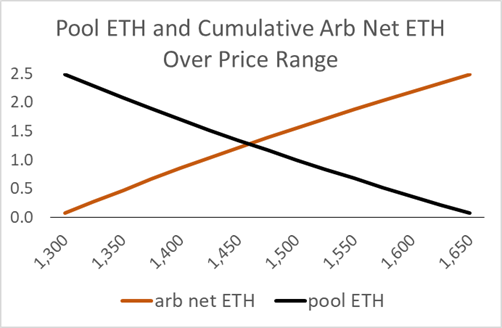
If the monopolist zero-fee LP were the arbitrageur, at any price his net ETH position would be the same; the sum of those lines, his net position on the contract, would be horizontal. With a constant net ETH position, his impermanent loss would be zero. This works because, unlike traditional markets, the option seller is not reacting to prices but setting them. The latency inherent in any decentralized AMM implies the price setter does not need any alpha, just an API to the lower latency centralized exchanges.

The LP would still have exposure to this net ETH position, but this is simple to hedge off the AMM with futures, as it would not need frequent adjusting.

If we add a separate margin account on the contract that held the LP's trades (with himself), they will net to a constant, his initial token position. The monopolist LP's net position on the contract would be represented as in the table below (on average).

Single LP with Exclusive Arbitrage Trading Access
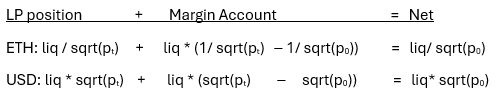
Thus, if the LP could trade for free, allowing him to dominate arbitrage, and he had a separate trading account on the contract, he could eliminate his IL without moving tokens on and off the blockchain or making other trades on different exchanges.

Multiple LPs

An AMM with only one LP would not work. An extensive set of LPs is needed to avoid centralization, which presents an attack surface for regulators and hackers; it is also needed to give the AMM unlimited scale. However, now we must consider LP competition. If we gave all the LPs free trading, a power law distribution of trading efficiency would invariably reveal a few dominant LPs monopolizing the arbitrage trading, shutting the slower LPs out and leaving them all exposed to IL as before.

Fortunately, the AMM provides a simple mechanism to allow all the LPs to arbitrage the price and hedge their positions simultaneously. This is because, on an AMM, the price is only changed by trades, so given a specific liquidity amount, a price change implies a specific change in ETH and vice versa. This makes it feasible to apply a rule using the LP's net ETH position on the contract to see if they qualify for the free discount.

Consider the following framework. Each LP gets a trading account in addition to their LP position. The key point is these accounts are netted, so like above, the LPs can retain a constant net position as the price moves significantly.

This can be adjusted to give them capital efficiency without changing the implications.[see footnote below] For my purpose in this post, this is irrelevant.

In the earlier example with one LP, his margin account's net change is calculated using the same liquidity as the pool because, with one LP, his liquidity is the pool's liquidity. This implied the LP's trades would always exactly offset his pool token changes. With many LPs, this is not so. A trade is against the entire pool, which is necessarily greater than any one LP. Thus, if LP(i) trades in a pool with many LPs, it will change LP(i)’s individual net position.

netETHchg(i) = (totLiq - liq(i))/totLiq *ETHtrade

As totLiq > liq(i), each trade changes the LP's net position, unlike when the monopolist LP trades with himself. For example, if an LP owns 10% of the liquidity, buying 1.0 token increases his margin position by 1.0 but decreases his pool position by only 0.1.

Assume LPs can only trade for free in the following conditions:

Buy for free only if

PoolEth(i) + MarginEth(i) - initEthDeposit(i) < + 0.01

Sell for free only if

PoolEth(i) + MarginEth(i) - initETHDeposit(i) >  - 0.01

If we assume the LP hedged his initial ETH deposit off-chain, the rules basically say if an LP is net net long, he cannot buy for free; if the LP is net net short, he cannot sell for free [presuming she hedged elsewhere initially, her ‘net net' position is her net position minus her initial deposit, as we assume it is hedged].

To see how this works, assume we have two LPs, Alice and Bob, with equal amounts of liquidity. Both Alice and Bob start with pool ETH positions of 990, and they have zero positions in their margin accounts. The trading fee is 0.5%, so all the price changes in this example are only profitable opportunities for Alice and Bob.

LP Pool, Margin, and Net ETH Balances
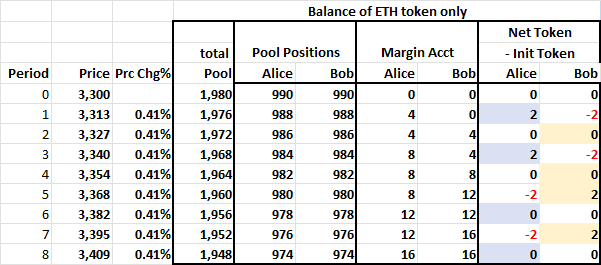
Assume the price initially rises by 0.41%, generating a arbitrage opportunity for the LPs. Alice wins the race and arbitrages this price discrepancy, setting the AMM price at its new equilibrium level of $3,313. She bought 4 ETH, and her pool position declined by 2 for a new ‘net net’ ETH position of +2. LP Bob just sees his pool position decline and has a new net net ETH position of -2; Bob is short, and Alice is long.

Alice cannot arb the AMM if the price rises again due to the rule preventing long LPs from buying at zero fee. If the price rises, Bob will win the arb race (by default), and LP’s Bob and Alice are each flat again. In the table above, Alice buys in the rows where she has a light blue box, and Bob buys in the rows where he has a light orange box. They can only buy when their net net position is flat or negative when prices are rising. This prevents Alice or Bob from dominating arbitrage.

If the price immediately went back down after Alice initially arbitraged the pool, only Alice could arbitrage the pool price. This is because in period 1, Alice is long, and Bob is short, so Bob cannot sell for free, while Alice can. When she does sell, she restores the initial net position for both herself and Bob. Alice’s extra trading is benign.

The LPs will experience net token position changes for single trades or small price movements. Over longer price movements, however, each individual LP's net token change would be insignificant, and assuming the LP hedged, their net net position would be insignificant.

There is no reason to pay arbs to set AMM prices, as the latency in decentralized blockchains implies arbitrage requires no special expertise, unlike the price discovery on the lowest latency exchanges. External arbitrageurs generate a deadweight loss for high-latency decentralized AMMs, so there is no trade-off with price efficiency.

A specialist with fast APIs and redundant arbitrage bot programs distributed in the cloud could manage a bot for a set of LPs. If the contract allowed LPs to whitelist another address that could do one thing on his account: trade for zero fee. The rule would prevent this arb vault manager from overtrading some accounts at the expense of others, as either it would single out one account for trades that cancel out, like in the case of Alice buying then selling above, or quickly find that her accounts that have traded first in one direction can no longer trade in that direction. One could cap trade size so the arb vault manager does not max out a trade on an LP to generate a profit for the other LPs. Competition among such specialists would allow passive LPs to get most of the benefit from arbitrage/hedging without creating and running their own arb bots.

It wouldn't work on coins not traded on major centralized exchanges because it presumes the true price is common knowledge. The next Shina Ibu will have to first trade on a conventional AMM. Yet, that's a minor amount of AMM volume.

Alternatives

As the equilibrium price is presumed to be on CEXes, and an equilibrium price implies net zero demand trading, one could use an oracle to update the AMM's last price to this price just as an LP arbitrage trade would. Over time, the LP net token changes would not be explicitly tied to price changes such that LP position values had negative convexity (i.e., linear in the square root of price). The main problem for oracle-based AMMs is centralization. This creates an attack surface for hackers. It also creates an attack surface for regulators, as the SEC knows where American Chainlink CEO Sergey Nazarov, for example, lives. Once they figure out how to do it—it took regulators several years to shut down InTrade—they will prevent his company from supporting anything that competes with regulated industries like finance and sports betting because regulation’s quid pro quo is protection from competition. Another problem is incentives, in that with more players with different actions, the state space complexity increases exponentially, so any solution will be more costly and less efficient. Arbitrageurs with more skin in the game would invest more time exploiting the oracle than the oracle would defending itself, especially as it requires a collective decision-making process and will be much slower to respond.

A decentralized limit order book (LOB) could avoid IL like an oracle-based AMM by allowing the LPs to move their resting limit orders costlessly to the latest CEX price, but there would be several problems. First, on-chain LOBs aspire to look and feel like the trading interfaces we are used to on centralized exchanges, so they emphasize low latency. Low latency leads to quasi, if not complete, centralization, an attack surface, and, more importantly, insiders who will get the equivalent of co-located server access. As third parties do not audit these ‘decentralized’ exchanges, the LOB leaders or a lower-level dev could sell undisclosed privileged access, and the costs would be virtually zero. It would take a lot of faith to presume they are immune to this subterfuge. Secondly, it would require many messages to cancel and replace resting limit orders. Unlike my mechanism, where one account rectifies the mispricing, on an LOB each LP account must be adjusted separately. On a CEX, these cancel-and-replace orders are costless, but if the blockchain is marginally decentralized, it will cost a few cents, and zero is a significant price point. Lastly, no one has presented a mechanism to incent a manager to oversee a set of LPs who wish to outsource their active management coherently. The LPs would still compete for favorable queue positioning, making it needlessly complicated and shutting out potential passive LPs.

The auction approach proposed by Maollemi et al. lets people bid to be the zero-fee trader. In that approach, the LPs would sell their right to fees to an arbitrageur who would get privileged zero-fee trading rights over some future period. The bidder pays a lump sum to the LPs, and the trading fees for that period go to the bid winner (meaning his trading fees return to him, so he trades for free). Assuming risk-neutrality and zero capital costs or other expenses, the arb would pay the expected arbitrage profit, which equals the expected LP convexity cost. They would also pay for the expected noise trader volume. Considering the arb bidder would be exposed to risk in that actual volatility and noise trader volume will be much lower than expected on occasion, he would pay considerably less than the expected value of the arbitrage opportunity and noise trading fees. The arb would have to hedge his trades on a different exchange, requiring extra collateral, and have to move tokens on and off the blockchain between those two exchanges (always losing one and gaining another). Lastly, frequent novel auctions can be manipulated, which means they will, especially at first.

Conclusion

The signature AMM is the ETH-USDC 5 bps pool on the Ethereum mainchain. Over the past 12 months, it has generated about $44MM in LP fee revenue and experienced $54MM in convexity costs. Yet even if LPs were, in aggregate, making a profit, the convexity cost is still significant and unnecessary. Given that the entire Uniswap AMM market is 4x the above pool, and there are other AMM protocols, that's several hundred million dollars a year wasted annually. The good news is this can be eliminated, propelling AMMs out of their doldrums and securing a long-term solution to an essential blockchain mechanism: swapping coins.

Most crypto people do not intuitively understand an LP's convexity costs, but they are not some new speculative theory (e.g., hedge fund sniping). Gamma, convexity costs, and theta decay have been analyzed empirically and theoretically for the past 50 years. They are the unavoidable consequence of convex payouts based on an exogenous underlying stochastic price. Constant product AMMs that link trade amounts to price changes, combined with the latency, allow the derivative owner (LP) to both hedge and set the underlying price simultaneously.

I haven't met anyone who understands this because they would be excited if they did. It's not often you find ways of saving hundreds of millions of dollars a year. My friends in academia or tradFi don't have much interest, let alone knowledge, of AMMs. My acquaintances in crypto, even those actively building AMMs, don't understand convexity beyond the technical definition, so they do not think it is a big deal. Fear of convexity costs is the beginning of AMM wisdom.

I wrote my dissertation in 1994 on low-vol stocks, noting they generated abnormal returns because they generate a slight premium to the market at 30% less risk (see here for a history of low-vol investing). I took a job as a bank risk manager but was busy pitching the idea to various asset managers, including several at the major investment banks. They didn't reject what I was saying but were always eager to know if well-known people or institutions in this field were on board. They weren't, and no one thought a fund offering virtually the same return as the SP500, regardless of risk, was compelling. I was out by the time low-vol investing started to grow. The responses I get from crypto people to this idea are similar.

It's not an abstract argument, just MBA-level finance. My best hope for this approach is that in a few years, LLMs will pick it up as they scrape the web for data, and via pure logic, over a couple of years, ChatGPT6 will use it as an answer for 'How do I remove impermanent loss?' There is pleasure in just being right about something important. 

footnote

In a levered AMM, the initial pool amounts are multiples of the initial deposit. This implies the LP starts with debits in his margin account for both tokens. The process works as follows:

Take an initial ETH deposit, ETH0. Given the initial price, p0, and assuming a leverage of 20x, apply the following liquidity to that LP

liquidity = 20*sqrt(p0)*ETH0

Given that liquidity, the initial USD deposit, also levered 20 times, is calculated:

Initial USD deposit = liquidity*sqrt(p0)/20

The objective of monitoring the LP’s net position for free trading is the same as above. Here, the initial margin account is negative, and the LP is susceptible to insolvency. However, a more pressing concern is whether the LP will be insolvent in one of the tokens, even though their total position value is positive. A pool where all the LPs are solvent, but the LPs have zero of one of the tokens would prevent purchases of that token. The solution is to allow liquidation based also on the minimum net position for the LP in the two tokens.

If the LP actively hedges its position, its net position will be constant in both tokens, so LPs would only be subject to liquidation if they exposed themselves to IL out of negligence. 

Wednesday, March 13, 2019

Antifragility is just Hormesis (to the extent it works)

In Nassim Taleb’ book Antifragile he emphasizes that ‘if you see a fraud and do not say fraud, you are a fraud,’ I am thus compelled to note that Antifragile is a fraud because its theme is based on intentional misdirection. The most conspicuous and popular examples he presents are also explicitly mentioned as not the essence of antifragility. Indeed, incoherence is Taleb’s explicit strategy, as the Wikipedia entry on Antifragility notes Taleb presents his book in a way to make it difficult to criticize.

I bring this up because last month I was listening to a Joe Rogan podcast where they mentioned hormesis, the concept that small amounts of a toxin or stressor strengthen an organism. The guest noted hormesis was discovered in the 1950s when researchers noticed a little bit of herbicide paradoxically makes plants stronger. Actually, this phenomenon was found back in 1888 concerning yeast, though the basic idea is probably timeless in that everyone understands exercise strengthens muscles while immobilizing a limb after an injury leads to atrophy. A glass of wine a day is a tonic, though too much leads to cirrhosis. The term Mithridatism comes from King Mithridates (160 BC) self-administering small amounts of a toxin to build up his immunity, so this is a very old idea. 

tweeted that Taleb thinks he invented hormesis, whereupon Taleb quickly noted that antifragility is not hormesis, and Antifragile explicitly mentions hormesis and its 1888 discovery, as well as Mithridatism. A snippet of his Twitter rebuttal is here. Tweets are not the place for snarky subtlety. My point was that far as antifragility works, it's hormesis, in spite of Taleb's qualification that "hormesis is a metaphor" for antifragility. This got me wondering how such a contradiction happened.

Taleb states his neologism antifragility is "beyond resilience or robustness." He defines antifragility more precisely as "a convex response to a stressor or source of harm, leading to a positive sensitivity to increase in volatility." Thus hormesis is not an example of antifragility, because, in the parlance of finance, hormesis is like having a positive but modest beta, while antifragility is increasing the value of a portfolio by increasing its gamma. Gamma is a measure of convexity, the signature feature of a put or call option, and in uncertain environments, a higher gamma leads to a higher value.

The common takeaway of Antifragile, however, is simple resilience. For example, in Jonathan Haidt's book the Coddling of the American Mind he credits Taleb’s concept of antifragility for arguing that protecting students from ideas they find offensive leads to them becoming more fragile, anxious, and easily discouraged. Actively confronting ideas we don't like makes us tougher and smarter, or as JS Mill wrote, ‘he who knows only his own side of the case knows little of that.’ Haidt's book mentions unstructured play for children, the immune system, and exposure to peanuts as examples of Taleb's concept of antifragility. Wikipedia’s entry on antifragile gives as its primary example that of bone density being strengthened by exposure to stress. These are all examples of hormesis.

Convex Payoff
If you own an option you have positive convexity and benefit from higher volatility; you are long volatility (aka long vega). It has long been known that financial options, especially out-of-the-money put and call options, have poor average returns. A good example is provided by VXX ETF, which is long vega and loses money with about the same Sharpe ratio as the SP500 index. Being long vega is like shorting the market, good in bad times, but in the long run a bad investment.

Thales
Taleb is aware of this and states that good antifragile things are not financial options because they "are sold by someone," but rather real options, which he thinks are free: "we don't pay for options given to us by nature and technical innovation." His prominent example here is Thales of Miletus. Aristotle gave us the story that Thales secured the rights to wine presses at a relatively low rate, which is an option: he had the right, not the obligation to use the wine presses. When the harvest proved to be bountiful, and so the demand for the presses was high, Thales charged a high price for their use and reaped a considerable profit. Taleb states the key to Thales's fortune was his awareness of his 'lack of knowledge,' in that as he owned an option he enabled himself to benefit from uncertainty.

I do not have data on wine presses circa 600 BC, but currently, such options are generally over-priced. For example, in futures markets, there is a thing called the basis, the difference between the future and cash price of a good reflecting the yield on the asset vs. the opportunity cost of money (ie, the interest rate). One of the components of that basis is the convenience yield, in that if there is a shortage, having the actual commodity will have a great value. For goods subject to shortages (eg, wine presses), this increases the cash price over the future price because having the good on hand can be very valuable in a crisis. William Easterly has argued that Western countries dumping grain on African countries during shortages deprives farmers of essential farmer revenue that comes from crises; often this profit pays for breaking even during normal times, so removing it discourages endogenous markets. Spikes in demand are a large part of any asset owner's income, statistically anticipated and priced into well-functioning markets. Simple awareness of a 'lack of knowledge' about future demand is not helpful, because it presumes the seller assumes the convenience yield or option value is zero. It may have worked in 600 BC, but markets have removed that inefficiency. 

Taleb gives other examples, for instance: avoiding doctors, having different alternatives on vacation or for dinner, the ability to switch jobs, a rent-controlled apartment, or being married to an accountant but an occasional fling with a rock star. To the extent these options are desirable, they are not underpriced, and certainly not free. People realize this, which is why they are rarely mentioned as examples of antifragility by Taleb's many supporters. The bottom line is that things with convexity are too costly in general because people love lottery tickets; convexity is not the essence of any antifragile example because they are generally not good investments (antifragility is supposedly a good investment or strategy). 

Another misleading application is in biology or economics, where populations or markets that have had to withstand more competition and external variability dominate those with benign environments. A bacteria population in the lab loses its ability to withstand stressors, an industry protected from new entrants loses its ability to compete when technology changes the game, or an industry protected against failure becomes bloated and less robust. Systems that allow or even encourage failure thrive relative to those that protect its members from failure. In economics, the basic idea of exiting losing businesses is perhaps the most crucial advantage of the free market over socialism. Failure strengthens the herd, whether animals or firms

Taleb states that his notion of antifragility is behind the following: "evolution, culture, ideas, revolutions, political systems, technological innovation, cultural and economic success, corporate survival, good recipes, the rise of cities, cultures, legal systems, equatorial forests, bacterial resistance." Success within these domains comes from looking at the competitive success of groups benefiting from hormesis vs. those insulated from it. Competition leads to the resiliency and efficiency needed to survive.

Back to his definition of antifragile, it is not that the prospering agents are convex to stress, rather that as survivors their progeny takes over the extinct's lebensraum; the dynamic effect of robustness in a system based on survival of the fittest looks like convexity.  Indeed, Taleb notes the property applies to the group, not the individuals: "the surviving cohort is stronger than the initial one—but not quite the individuals since the weaker ones died." So here, like with hormesis, he notes it is a metaphor, not a precise analogy. He is quite aware that such systems are not direct examples of antifragility because the agents that generate convexity at the higher level are merely robust, via hormesis, and their germline exhibits convexity. 

A robust business has to innovate because every business model changes over time. Jeff Bezos notes success takes someone with a stubborn vision yet flexible on details, because without a strong vision one's strategy overreacts to current failure or success, while without flexibility one cannot adapt when things do not work precisely as planned, as they always do. Note here we see a classic example of 'moderation in all things,' where the optimum lies between an excess and deficit.  In contrast, Taleb describes a caricature of vision via his "teleological fallacy" which is the "illusion that you know exactly where you are going." One could go on all day about the inadequacies of strawmen, as Taleb does.

An industry protected from failure or change via union work rules or bailouts removes the micro-instability needed at all levels of a company to develop innovation, robustness, and a healthy familiarity with failure. While some rules and regulations are good, most are merely a pretext for barriers to entry protecting current workers and firms. This is just an argument for allowing stress, and the resulting failures it implies; that is, for hormesis to do its thing.

Becoming excellent first requires a lot of domain-specific hard work, with a focus that enlarges some things while excluding others. Jordan Peterson argues that flow comes from operating at the edge of our competence, with enough mastery to generate satisfaction yet enough novelty to be challenging. To an outsider, such explorations can seem like random tinkering, but for an expert, it is a variation on their unusual intuition. Suggesting that the general strategy of accumulating convex exposures is the key to success is a profound error, as in the difference between the benefit of anger, and anger directed at the right person at the right time and in the right way.

An essential attribute of someone who innovates is their ability to embrace failure. Adversity is a great teacher, why mother giraffes knock their newborns down just after first learning how to stand;  they have to learn quickly on the African grasslands. Embracing failure is easy to say but hard to do, which Taleb acknowledges. Actually, he doesn't explicitly acknowledge this, but as he never mentions why he worked for several banks while he was a trader (blow up?) or the fact that every close friend he mentions in Antifragile is highly successful, suggests he sees failure as a characteristic of unremarkable losers.

Failure will always be costly, and due to moral hazard, no one will sell you a put option on your failures (you would fail on purpose to cash in on your put option).  In addition to acclimating ourselves to failure, just as useful are the Christian virtues of faith, hope, and love. If you have faith in what you hope for regardless of your economic success and love someone who loves you for who you are, failures under the sun are not so terrible. This allows you to explore more virgin territory so that when the unexpected happens, you might be in the right place at the right time.

There are two ways to generate an option payoff. One is to buy an option; another is via dynamic replication, which involves doubling down a position as it becomes more in-the-money. The outsized success of winners over losers in dynamic systems generates large convexities, but to be a winner, the keys are not buying options, but rather, via resilience acquired through hormesis, surviving long enough to achieve success indirectly via a combination of vision, excellence, and flexibility (obliquity). To describe the essence of this as creating option payoffs focuses people on explicit optionality, as opposed to the optionality that comes via hormesis. Resilience generates outsized winners in dynamic zero-sum competition over time as the survivors take over. This is why everyone mentions examples of hormesis, waves their hands, and hopes no one notices the bait-and-switch.

Promoting the new idea that acquiring options on the next Black Swan is the basis of "our own existence as a species on this planet" is the sort of hyperbole you hear at TED talks. It is the sort of thing bureaucrats love because they are generally too high up to have much domain-specific expertise, and the incoherent but plausible-sounding theme allows one to talk about strategy without actually knowing anything specific. Then you give examples of your great idea that are really something else entirely, and fade to black...


Tuesday, August 13, 2013

Is The Low Vol Anomaly Really a Skew Effect?

The idea that low volatility stocks have higher returns than high volatility stocks is difficult for economists to digest, because it's so hard to square with standard theory.  It brings to mind Dostoyevsky's line "If God is dead, then everything is permitted." Similarly, when one sees their favored theory as being abandoned, it seems like all explanation is lost and chaos reigns. Yet, when a wrong theory is adopted, well, as the ever-logical Bertrand Russel used to note, if 1+1=1, everything is both true and untrue.  We need a framework to evaluate reality, and it has to be consistent.

Alas, many frameworks are largely untrue, leading to inconsistencies and explanations that are transparently tendentious.  The sign of a bad Weltanschauung is that explanations for reality become more and more convoluted, like epicycles in Ptolemaic astronomy. I'll gladly enjoy the hypocrisy of those who don't share my worldview because, as the Detroit bankruptcy has reminded us (eg, its bankruptcy blamed on too much or too little gov't), people might admit tactical errors, but they'll go to their grave with their worldview (see Max Planck).

Consider the recent papers arguing that low volatility is really just a skew effect, in which case their worldview is safe. In the recent Journal of Economic Perspectives, longtime behavioral finance academic Nicholas Barberis wrote a paper on Kahneman and Tversky's prospect theory (that's Nobel prize winning Danny Kahneman, who's unimpeachability seems somewhere around that of Nelson Mandela)  It's helpful to note that this insight is 34 years old, because many  seem to all think these newfangled behavioural insights are going to revolutionize economics as if they haven't been applied continuously over the past generation.

Barberis goes over his Barberis and Huang (2008) model where prospect theory is used to motivate the hypothesis that a security’s skewness in the distribution of its returns will be priced. A positively skewed security— a security whose return distribution has a right, upper, tail is longer than its left tail—will be overpriced relative to the price it would command in an economy with standard  investors. As a result, investors are willing to pay a high price for lottery-ticket type stocks.

Barberis references several papers, including Bali, Cakici, and Whitelaw (2011), and Conrad, Dittmar, and Ghysels (here's the 2009 version, though a more recent version was just published in the Journal of Finance).  He also finds it relevant to the underperformance of IPOs, the low average return of distressed stocks, of bankrupt stocks, of stocks traded over the counter, and of out-of-the-money options (all of these assets have positively skewed returns); the low relative valuations of conglomerates as compared to single-segment firms (single-segment firms have more skewed returns); and the lack of diversification in many household portfolios (households may choose to be undiversified in positively skewed stocks so as to give themselves at least a small chance of becoming wealthy).

It seems like an orthogonal way to address these puzzles compared to the constrained rational approach offered by Betting Against Beta, but there's a problem, and it's that the well-know equity risk premium has a negative skew relative to what's considered less premium-worthy, long-term bonds. That is, equities in general have a lower (ie, more negative) skew than bonds, and this is the most prominent 'risk premium', so it must not be an exception to a rule.

US Monthly Data 1962-2013

10-year US T-Bond
SP500 Index
AnnRet 7.05% 7.28%
AnnStdev 6.86% 15.05%
Skew 61.09% -42.16%


Note that indices have negative skew while individual stocks have positive skew.  This is because correlations go up in down markets, and this predictable tendency creates a problem for idiosyncratic skew pricing models.  That is, in the CAPM and other asset pricing models, risk factors have prices that are linear in the covariances, otherwise there is arbitrage, the essence of the Arbitrage Pricing Theory: whatever risks are priced, they are based on additive moments, so risk and returns are linear functions.  Now we have priced risks that are not just diversifiable, but change sign depending on what else is in the portfolio.  If true, there is an implausible level of profit to be had from buying portfolios and selling the constituents.

As an ivy league confabulator Barberis deftly ignores this inconsistency and instead notes that the equity risk premium makes perfect sense given Benartzi and Thaler’s (1995) idea that if you focus only on the net changes in wealth (technically, U(x) vs. U(w+x)), you can get this to work in cumulative prospect theory, because losses hurt more than gains, so one gets paid to take risk in this case.

Alas, there's a limit to how much skew and variance can both be priced in the same universe, where people love positive skew and hate variance.  If skew explains most of the volatility anomaly, that implies people can't be globally risk averse because they would like extremum up-moves too much, and these happen proportionally more for volatile stocks.  Yet if that's true there's no risk premium of any sort, because people would simply buy single assets or derivatives and have no incentive to mitigate risk via bundling and arbitrage.  This has been shown formally by Levy, Post, and van Vliet (2003), but it should be intuitive: skew is positively correlated with volatility for stocks with lognormal returns, so there's a point at which one's love of skew dominates one's fear of volatility. If that point is reached, volatility is always less costly than skew is beneficial. This constrains the size of the skew-loving effect to be an order of magnitude less than the risk premium if global risk aversion exists. If global risk aversion does not exist, then the rest of the general framework presented in simply meaningless.

 So we have  prospect theory explaining the overpricing of high volatility stocks due to skew, the underpricing of equity indices due to 'narrow framing.' One could add that prospect theory is used to explain why people overpay for longshots at the horse track, in that 'decisions weights' applied to payoffs prospect theory are observationally equivalent to overoptimistic probability assessments (see Snowberg and Wolfers (2010)), and that Danny Kahneman is an admirer of Nassim Taleb's Black Swan theory, which argues that small probability events are generally underappreciated. In other words, whatever the probability density function and expected return, it's explained by prospect theory.

Skew also shows up also in the recent publication of Conrad, Dittmar, and Ghysels (2013), who are incredibly meticulous in their analysis of how skew relates to future returns, highlighting what three top researchers over several years can do to data.  Yet, they then ignore the elephant in the room, that is, if volatility is negatively priced and skew is positively priced, how do these both exist in equilibrium?  It should be hard for these authors to say they don't care, because they are very exhaustive in their analysis, noting at one point:
 We use several methods to estimate [the stochastic discount function] Mt(Ï„) that allow for higher co-moments to influence required returns. These methods differ in the details of specific factor proxies, the number of higher co-moments allowed, and the construction of the SDF. 
Alas, as usual in analysis of SDFs, there is no take-away input one can use to measure risk, no soon-to-be-indispensable tool, just a promise that this has all been vouchsafed against high-falutin theory and so 'it's all good.'  Consistency is a good thing, but only in certain dimensions. One of the authors, Dittmar (2002), wrote a very nice paper for the Journal of Finance in 2002 noting that if you restricts a non-linear pricing kernel to obey the risk-aversion needed to ensure that the market portfolio is the optimal portfolio, the explanatory power goes away of higher moments. With all the abstruse checks in this paper, one would think he might want to address that issue, but instead he ignores it.

I'm sure former JoF editor Cam Harvey read this while nodding approvingly throughout (he's referenced every other page, and a big believer that risk explains most everything in finance).  While understanding SDFs and their risk premiums won't help you get a job at a hedge fund, it will help you get published and be popular among publishing academics.

I agree that skew is important, as it measures the upside potential that delusional lottery-ticket buying investors love, and because of relative wealth preferences, arbitrage is costly and their footprint remains.  That's a mathematically consistent story.  Skew loving effects can't exist on the same par with variance hating effects in any consistent story about asset returns. Is this important?  Consistency can be overdone, but I don't think this is foolish because one tends to see what one believes rather than vice versa, and I think there's more power and predictability in viewing volatility as merely a desirable attribute for delusional investors, as opposed to something that pays you a premium.

Paradoxically, behavioral refinements such as prospect theory are preventing needed outside-the-box adjustments and are used to maintain a defective status quo, one that has been wrong on a profound empirical issue for 50 years (ie, the risk premium). These putative revolutionary insights allow academics to wax eloquent on how their complex paradigm handles subtleties such as any of those 50 behavioral quirks, and outside commentators are pleased to be part of a new vanguard, obliviously marching in basically the same, pointless, confabulating path.  

Sunday, June 09, 2013

Kahneman Fast and Loose

There's a short Danny Kahneman interview at the Daily Beast here.  He notes why your best friends may not be your best advisors:
Friends are sometimes a big help when they share your feelings. In the context of decisions, the friends who will serve you best are those who understand your feelings but are not overly impressed by them. 
 That's the Kahneman I love to read, profound and interesting. But then he follows with this sentence:
For example, one important source of bad decisions is loss aversion, by which we put far more weight on what we may lose than on what we may gain. 
I don't see loss aversion as being nearly as prevalent as lottery-loving: that is, picking things with small probabilities of big gains, as opposed to avoiding things with potentially large losses.  Most really bad investments, those with the lowest expected returns, are things with large potential losses (lottery tickets, horse races, highly volatile stocks, options, penny stocks, etc.)  This means people don't avoid them too much, rather, they prefer them too much.

But that's only one class of bad investments with large losses.  Then there's picking up pennies in front of a steam roller, the kind of trade Kahneman's good friend Nassim Taleb argues is too common, where one basically sells insurance or options too cheap, making money most of the time but then occasionally blowing up and moving on to the next sucker.  Kahneman seems highly respectful of Taleb's work, and neither try and reconcile these ideas, even though they are really at the top for both.  That makes them more like interesting magazine writers (eg, Carl Zimmer, John Horgan) than scientists.

Loss aversion in practice is a curiosity, not common in its domain relative to riffs on its opposite.  I think people who love quoting him merely because once you allow irrationality in equilibrium, you are no longer constrained, and Kahneman gives one the authority to do this.  So, as much as I enjoy many things he says, I'd say he has been an enabler of sloppy thinking, net net.

Sunday, May 12, 2013

Weekly Roundup

Jon Vol sent me a little email saying he has a blog post on Taleb, and that it got picked up by a Taleb fansite, where at the bottom it is classified as "Filed Haters || Tagged Falkenstein." I'm not just a Hater, but rather, a type that can be applied to others! I wonder what our distinguishing characteristic is in their eyes?

**************************************************
 “Pride gets no pleasure out of having something, only out of having more of it than the next man.” C S Lewis, Mere Christianity 

****************************************


 Now that wrestling is trying to get back into the Olympics, they are considering getting rid of singlets! I'd say, it's about time. Singlets simply aren't cool, and if high school kids suited up like cage-fighters I think the sport would be more popular.

******************************************
 Heritage's dismissal of Jason Richwine is pretty rich indeed. To recap, he coauthored a study critical of immigration, basically saying that the new immigrants from Mexico would receive more benefits than generate in taxes. Someone looked up his 2009 dissertation, and it had the racy title 'IQ and Immigration Policy.'

 It's truly a taboo topic, as demonstrated by his Harvard thesis adviser and famous labor economist George Borjas saying 'I have never worked on anything even remotely related to IQ, so don’t really know what to think about the relation between IQ, immigration, etc.' The NLS panel data that Borjas studies all the time has an IQ proxy (AFQT) in there that is highly powerful in regressions, and he has to know this. He also knows that the subject is not good for one's career, so I understand why he has trained his mind to not think about it, but it's surely an elephant in the room.

 Interestingly, Edward Miller writes a lot about race and IQ, which is probably why he spent his career in an academic backwater. His seminal 1977 piece Risk, Uncertain and Difference of Opinion was really the first paper giving a theory as to why risk and return are inversely correlated, and was the first person to state in a journal one should invest in low beta/volatility stocks for this reason.

******************************

If you can read Dutch, there's a new review of my book The Missing Risk Premium out there in a CFA magazine. I can copy, paste into a translator, and get a broken English translation that is good enough.

******************************

Tuesday, January 22, 2013

A Happy Skewness Delusion

There are several papers asserting that investors like positive skew to their returns. This is because empirically investors tend to be highly undiversified, and have a bias towards highly volatile stocks, and so they seem to want big lottery-type payoffs (incidentally, this is the exact opposite to what Nassim Taleb states is common, that people prefer payoffs that have high modes and low means--negative skew). Anyway, In the early days of portfolio theory, reconciling the desire to take such big risks was considered side by side with minimizing variance, as Markowitz looked at both approaches back in 1952 but eventually just sided with the total variance approach, and preference for positive skew was abandoned as an exception to a mean-variance rule.

Alas, it keeps cropping up, as in papers by Kraus and Litzenberger (1976), Harvey and Siddique (2000), or Statman and Shefrin (2000). I think Statman and Shefrin do the best job here, notingg that this isstrictly irrational, in that if there is a skewness preference and a risk aversion preference, then the skewness preference will be pretty tame, and as Post, van Vliet and Levy (2006) note, second order relative to the equity risk premium (eg, less than 1%). Rational risk averse investors would not take a lot of risk with some of their assets, at least, not enough to affect pricing much. That's why I like the Statman and Shefrin model, because they explicitly say this doesn't make sense if investors are rational risk averse investors (at least, with risk conventionally defined), unlike Harvey and Siddique who try to cram this into a fully rational model and ignore how it all fits together.

In any case, I was looking at this and came across an interesting take by Brunnermeier, Gollier and Parker (2008).  The model gets pretty convoluted but the intuition is very interesting.  The benefits of being ex ante biased towards skewed assets outweighs the ex post costs of having inefficient portfolios.  These highly skewed assets make it possible to conceive of an aspirational state of much greater wealth, as such an event is possible, though improbable.  Your excessive optimism makes you better off because you anticipate a small probability payoff incorrectly, but since your happiness is the discounted value of these beliefs, you are a happier deluded self. Think about all the time you have spent considering what you would do if you won the lottery, as surely everyone has done that at least once. The cost can be pretty low (for a lottery ticket, $1), but the benefit of visualizing that fantasy pretty large, and it doesn't keep me in a debilitating stupor because I don't do this much (moderation in all things).  

Now, as an explanation of the low vol effect, I think this Brunnermeier et al model is inferior to the Shefren and Statman approach because it pretends to be a rational, general equilibrium model, when its not (funny how general equilibrium models built on fundamental preferences are usually quite parochial because of their limited assumptions).  But I like the intuition, or find it intriguing.  It's nice to think we are on a journey with sealed orders with some higher purpose that we aren't privy to, but it exists and is important. It may not be true, but it's comforting to think so, and doesn't really cost much. 

Tuesday, December 04, 2012

Taleb's Sokal Hoax

Taleb's latest book he mentions a little trick he played on academics, basically, he created a bunch of nonsense in abstruse mathematics just to highlight what fools they are. Here's his description of this work in Antifragile:
According to the wonderful principle that one should use people’s stupidity to have fun, I invited my friend Raphael Douady to collaborate in expressing this simple idea using the most opaque mathematical derivations, with incomprehensible theorems that would take half a day (for a professional) to understand ... Remarkably—as has been shown—if you can say something straightforward in a complicated manner with complex theorems, even if there is no large gain in rigor from these complicated equations, people take the idea very seriously. We got nothing but positive reactions, and we were now told that this simple detection heuristic was “intelligent” (by the same people who had found it trivial).
I presume this refers to his SSRN paper, Mathematical Definition, Mapping, and Detection of (Anti)Fragility. It contains a lot of unnecessarily complex notation, technically correct and totally meaningless. He basically defines anti-fragility as the difference between the expected value of a function and a function of an expected value over some arbitrary range of that function, and notes that nonlinear functions are more volatile than linear functions, and you want to be long convex payouts.

Taleb doesn't present any data suggesting it is useful for pricing or managing risk, just mentions some really simple examples (stress tests for where unemployment is 8% and 9% that are typical guesses of macro) that highlight how losses can increase exponentially for different assumptions. For complex systems like large corporations, assessing the effect of macro inputs is a similarly vague exercise if you've ever been witness to them (to get a sense, ask yourself what your net worth would be if GDP fell by 5% or 10%).

He then asserts:
It outperforms all other commonly used measures of risk, such as CVaR, “expected shortfall”, stress-testing, and similar methods have been proven to be completely ineffective... It does not require parameterization beyond varying Δp
So, the 'data' showing his equations are helpful are stress-test thought experiments, but this supposedly dominates this same test as well as everything else. Further, it does require density functions for the inputs, and functional forms, subjective thresholds, which for anything like a corporation is simply not amenable to such precision; for specific assets or portfolios there are more direct tools (eg, in options, kurtosis, twist, rho). Like so many things he says, this is not even wrong.

He tried to intimidate a journalist at FTAlphaville with this, and the journalist basically said 'whatever.' The paper was presumably accepted by Quantitative Finance, a journal where Taleb often publishes and seems highly favorable towards his work. This seems identical to the infamous hoax by Alan Sokal, a physics professor who submitted an intentionally meaningless article  to Social Text, an academic journal of postmodern cultural studies. However, Sokal was mocking the journal and its readers by publishing self-acknowledged gibberish. Taleb's mocking his biggest fans ('stupid', he calls them). I bet the journal editor won't find this very amusing.

By admitting that his models are merely "expressing [a] simple idea using the most opaque mathematical derivations, with incomprehensible theorems that would take half a day (for a professional) to understand", he's admitting his math does not add, it's merely to impress via excessive abstruseness. Surely many academics have created excessively technical articles reluctantly, but this shows real bad faith on his part, because presumably this journal aspires to apply rigor in pursuit of making ideas as clear as possible, not the opposite. I must admit it's kind of funny, but perhaps too mean.